
This page provides a selection of the specimens that have passed through the Fabre Minerals website and, due to their quality,
rarity, or significance as specimens from interesting locations, have been preserved as reference specimens in #MVM
| Quartz |
|
|
Fluorescent light (daylight)
|
|
|
|
EFF73AO1: Divergent group of Quartz crystals with a very well defined La Gardette habit, completely water-clear and very lustrous. The world famous quartzes from Corinto have an impressive aesthetic and even more so when, as in this case, they are perfect floaters.
Corinto, Curvelo, Minas Gerais Brazil
Specimen size: 10.1 × 8.4 × 4.8 cm = 3.98” × 3.31” × 1.89”
Main crystal size: 7.3 × 1.7 cm = 2.87” × 0.67”
|
|
|
|
Quartz with Rutile inclusions |
|---|
|
|
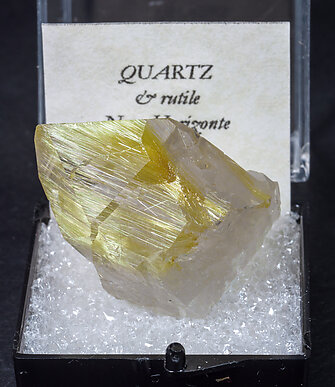
MR12AM8: Transparent and lustrous Quartz crystal with abundant oriented inclusions of acicular Rutile crystals. A Brazilian classic that we will send to the buyer in its original Perky box from the Robert J. Noble collection, which also contains the label.
Novo Horizonte, Bahia State, Northeast Region Brazil
Specimen size: 3.1 × 2.7 × 2.6 cm = 1.22” × 1.06” × 1.02”
Former collection of Bob Noble
|
| 
Front | 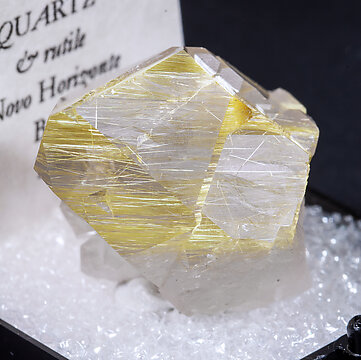
Side |
| |
|
|
| Quartz (variety smoky) with inclusions and Chlorite |
|
Front | 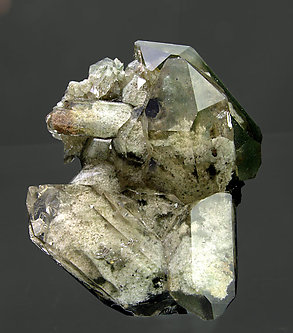
Side |
| |
|
|
|
|
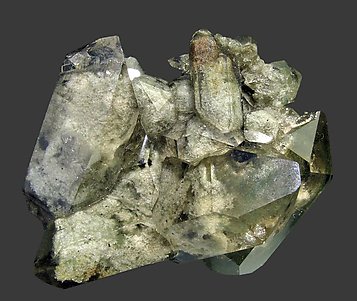
TM87L0: An interesting novelty of Tucson 2008 due to the quality and locality. Group of smoky Quartz crystals, some of them doubly terminated, with well defined faces and edges. Crystals are quite transparent with several inclusions, among others Chlorite.
Diamantina, Vale do Jequitinhonha, Minas Gerais Brazil (11/2007)
Specimen size: 5.7 × 5.6 × 3.5 cm = 2.24” × 2.20” × 1.38”
Main crystal size: 4.1 × 2.2 cm = 1.61” × 0.87”
|
|
|
|
Quartz (variety smoky) with inclusions and Chlorite |
|---|
|
|
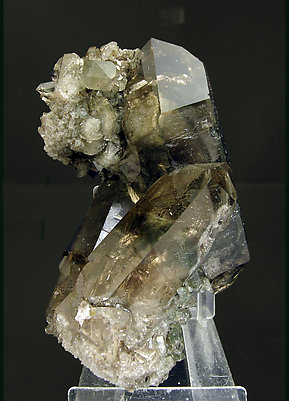
TT98L0: An interesting novelty of Tucson 2008 due to the quality and locality. Group of smoky Quartz crystals, one of them clearly dominant and doubly terminated, with well defined faces and edges. Crystals are transparent with several inclusions, among others Chlorite.
Diamantina, Vale do Jequitinhonha, Minas Gerais Brazil (11/2007)
Specimen size: 9.7 × 6.8 × 5.6 cm = 3.82” × 2.68” × 2.20”
Main crystal size: 7.7 × 3.3 cm = 3.03” × 1.30”
|
| 
Front | 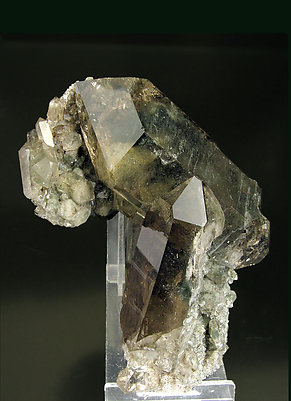
Side |
| |
|
|
| Quartz (variety rose quartz) on Quartz (variety smoky) |
|
Front | 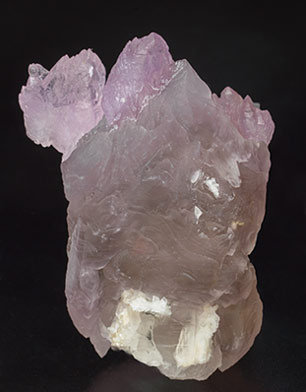
Rear |
| |
|
|
|
|
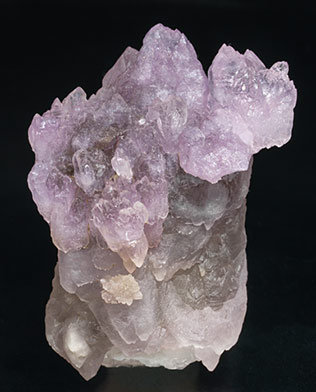
CB99AD3: Very aerial drusy aggregate of partially doubly terminated crystals with parallel growths and deformations and curvatures on their faces and edges and with an intense color and a coating a matrix of smoky Quartz.
Ilha claim, Taquaral, Itinga, Vale do Jequitinhonha, Minas Gerais Brazil (2002)
Specimen size: 7 × 5 × 3.7 cm = 2.76” × 1.97” × 1.46”
|
|
|
|
Quartz (variety smoky) with inclusions and Chlorite |
|---|
|
|
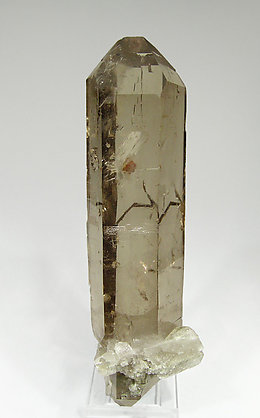
TM70P9: Doubly terminates crystal of excellent transparency, luster and color and with abundant and esthetic inclusions. We must note slight damage on one of the terminal faces but we are sure it does not detract from the quality of this excellent sample.
Diamantina, Vale do Jequitinhonha, Minas Gerais Brazil (11/2007)
Specimen size: 15.2 × 4.2 × 3.7 cm = 5.98” × 1.65” × 1.46”
|
|  |
|
| Quartz (variety smoky quartz) |
|
 |
|
|
|
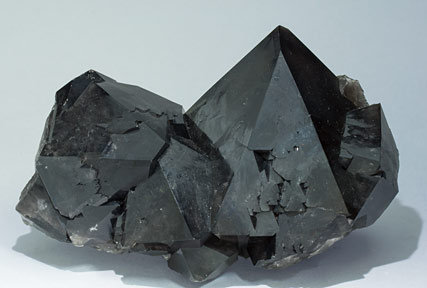
VD38AA7: Aggregate of very sharp dipyramidal crystals without prism faces and with the dark color, almost black, typical of these samples, naturally irradiated by uranium minerals scattered throughout the rocks of the locality. An excellent Brazilian classic.
Recruta farm, Vitória da Conquista, Anagé, Centro-Sul Baiano, Bahia, Northeast Region Brazil
Specimen size: 13.2 × 8.5 × 7.7 cm = 5.20” × 3.35” × 3.03”
Main crystal size: 9 × 6.5 cm = 3.54” × 2.56”
Former collection of A. Mayor
|
|
|
|
Quartz (variety rose quartz) |
|---|
|
|
TC46AN1: Group of Quartz crystals (variety pink quartz) of greater size and with much better defined faces and edges than usual in specimens from this locality. They are between transparent and translucent, with bright luster and an intense and uniform pink color.
We will ship the specimen in its original Perky box from the Robert J. Noble collection, which also contains the label, which shows that it was previously in the Melanson collection.
Pitorra claim, Alto da Pitorra, Laranjeiras, Galiléia, Vale do Rio Doce, Minas Gerais Brazil
Specimen size: 2.8 × 1.8 × 1 cm = 1.10” × 0.71” × 0.39”
Main crystal size: 2 × 0.6 cm = 0.79” × 0.24”
Former collection of Bob Noble
|
| |
|
| Quartz (variety rose) with Quartz |
|
 |
|
|
|
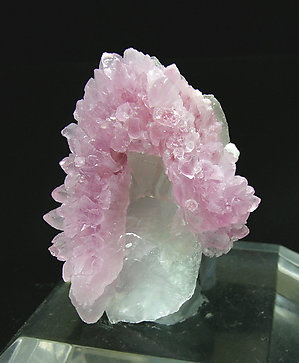
TR66J0: Beautiful miniature. A crown of well defined crystals of very deep color caps the matrix, a prismatic crystal of Quartz.
The specimen is from the Dick Nelson collection and it is with two labels, the original collection and another from the Mineral Cabinet of MaD Minerals.
Taquaral, Itinga, Vale do Jequitinhonha, Minas Gerais Brazil
Specimen size: 3.7 × 2.7 × 1.7 cm = 1.46” × 1.06” × 0.67”
Main crystal size: 0.4 × 0.3 cm = 0.16” × 0.12”
Former collection Dick Nelson
|
|
|
|
Quartz (variety rose) |
|---|
|
|
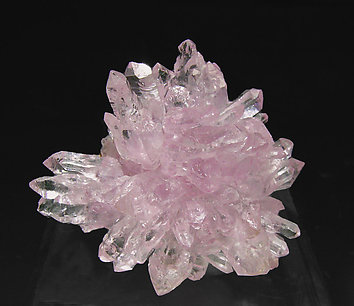
DR67P4: Divergent group of crystals better defined and more elongated than usual in this kind of sample. Color and luster are, furthermore, excellent.
The piece is with a label from the former collection: Kern Material, that we’ll send to the buyer.
Alto da Pitorra, Laranjeiras, Galiléia, Vale do Rio Doce, Minas Gerais Brazil
Specimen size: 4.3 × 3.4 × 2.3 cm = 1.69” × 1.34” × 0.91”
Main crystal size: 0.9 × 0.6 cm = 0.35” × 0.24”
|
|  |
|
| Quartz (variety rose) |
|
 |
|
|
|
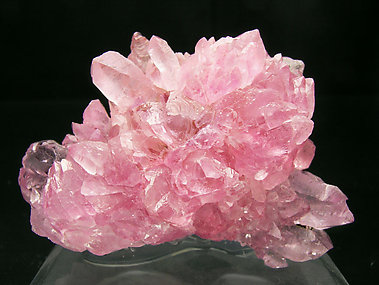
MB96L3: Druse of Quartz crystals with exceptionally sharp faces and edges, without the curvatures or deformation that we usually see in these specimens. Very intense color as well.
Alto da Pitorra, Laranjeiras, Galiléia, Vale do Rio Doce, Minas Gerais Brazil (11/2007)
Specimen size: 5 × 3.5 × 3.3 cm = 1.97” × 1.38” × 1.30”
Main crystal size: 1.2 × 0.6 cm = 0.47” × 0.24”
|
|
|
|
Quartz (variety smoky) |
|---|
|
|
MW13AM7: Parallel floater growth of two smoky Quartz crystals, transparent, with great luster and a very deep smoky color which is distributed in zones of variable intensity.
We will ship the specimen in its original Perky box from the Robert J. (Bob) Noble collection, which also contains the label, indicating that it was in the Melanson collection.
Linópolis, Divino das Laranjeiras, Vale do Rio Doce, Minas Gerais Brazil
Specimen size: 2.4 × 2.2 × 1.9 cm = 0.94” × 0.87” × 0.75”
Former collection of Bob Noble
|
| |
|
| Quartz (variety rose quartz) with Quartz |
|
|
|
|
|
TV73AM9: Group of Quartz crystals (pink variety) with irregular crystal forms, something typical in this type of specimen, but nevertheless sharp, between transparent and translucent, with bright luster and an intense and uniform color, and capped by a group of doubly terminated white translucent Quartz crystals. Very aesthetic.
Berilo Branco claim, Aimorés pegmatite district, Sapucaia do Norte, Galiléia, Vale do Rio Doce, Minas Gerais Brazil
Specimen size: 6.9 × 4.7 × 3.6 cm = 2.72” × 1.85” × 1.42”
|
|
|
|
Quartz (variety rose quartz) on Quartz (variety smoky quartz) |
|---|
Fluorescent light (daylight)
|
|
|
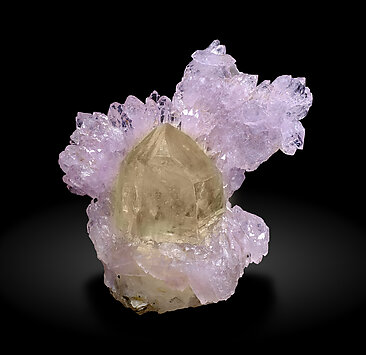
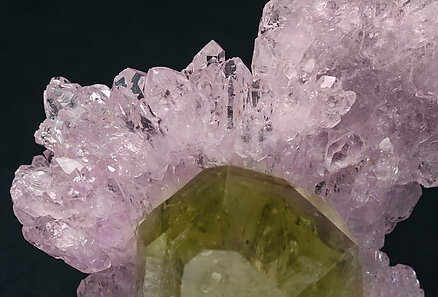
ELL93AP2: Very aerial polycrystalline growth of Quartz (pink quartz variety) with transparent crystals, very lustrous and deep pink, which seem to grow around an isolated and centered crystal of transparent Quartz (variety smoky quartz).
A classic, fine and elegant Brazilian specimen.
Ilha claim, Taquaral, Itinga, Vale do Jequitinhonha, Minas Gerais Brazil
Specimen size: 7 × 6.7 × 3.6 cm = 2.76” × 2.64” × 1.42”
Main crystal size: 4 × 2.4 cm = 1.57” × 0.94”
|
| 
Front / Photo: Joaquim Callén | 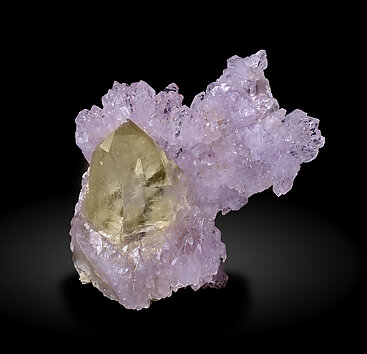
Side / Photo: Joaquim Callén |
|  |
|
|
| Quartz (variety rose quartz) with Eosphorite |
|
Front / Photo: Joaquim Callén | 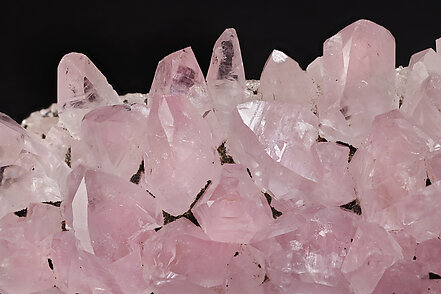
Detail / Photo: Joaquim Callén |
| |
|
Fluorescent light (daylight)
|
|
|
|
THA67AP8: Druse of transparent Quartz crystals, with very good luster and an intense pink color (variety pink quartz), with small spherical aggregates of Eosphorite.
Taquaral, Itinga, Vale do Jequitinhonha, Minas Gerais Brazil
Specimen size: 7.7 × 4.8 × 1.8 cm = 3.03” × 1.89” × 0.71”
Main crystal size: 1.1 × 0.7 cm = 0.43” × 0.28”
|
|
|
|
Quartz (variety rose) |
|---|
|
|
TQ96P5: A group of crystals with a considerable size for this variety. The crystals, that are very well defined, have zones of deep color, alternating with areas of clearer pink.
Taquaral, Itinga, Vale do Jequitinhonha, Minas Gerais Brazil (04-05/2008)
Specimen size: 7.8 × 4.2 × 3.8 cm = 3.07” × 1.65” × 1.50”
Main crystal size: 1.2 × 0.5 cm = 0.47” × 0.20”
|
| |
|
| Quartz (variety rose quartz) |
|
|
Fluorescent light (daylight)
|
|
|
|
TGR10AO2: Group of Quartz crystals (variety pink quartz), many of them doubly terminated, with an intense pink color, with transparent terminations and on a slightly smoky Quartz matrix.
Galiléia, Vale do Rio Doce, Minas Gerais Brazil
Specimen size: 7.8 × 6.1 × 4.1 cm = 3.07” × 2.40” × 1.61”
Main crystal size: 3.1 × 1 cm = 1.22” × 0.39”
|
|
|
|
Quartz (variety rose) on Quartz and Mica |
|---|
|
|
TL70H7: The crystals of pink Quartz, well defined, of intense color, bright and some perfectly transparent, form an elegant crown contrasting on a matrix of yellowish-white Quartz.
Ilha claim, Taquaral, Itinga, Vale do Jequitinhonha, Minas Gerais Brazil
Specimen size: 9.6 × 8 × 7.5 cm = 3.78” × 3.15” × 2.95”
Main crystal size: 0.9 × 0.4 cm = 0.35” × 0.16”
|
| |
|
| Quartz (variety rose quartz) |
|
|
Fluorescent light (daylight)
 |
|
|
|
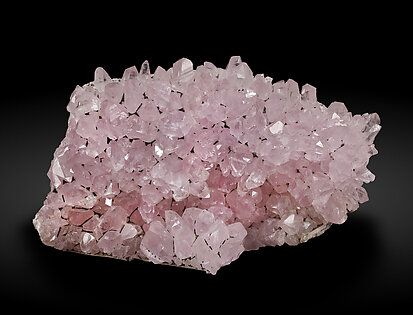
TA97AL5: A group of Quartz crystals (variety rose quartz) forming an arrangement reminiscent of a palisade on a matrix of the same mineral, with good luster, transparency and an intense pink colour. Particularly noteworthy is the well-defined crystal morphology, as rose quartz only rarely develops such sharply defined crystal faces.
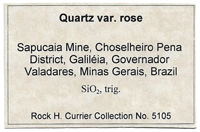
A classic Brazilian specimen, formerly in the collection of the late Rock Currier (No. 5105)
Geologically, the Berilo Branco claim is part of the Eastern Brazilian Pegmatite Province. Rose quartz crystallized in granitic pegmatites enriched in silica and volatile elements. Its pink colour is currently considered to be related to small amounts of phosphorus and aluminium incorporated into the crystal structure.
Berilo Branco claim, Aimorés pegmatite district, Sapucaia do Norte, Galiléia, Vale do Rio Doce, Minas Gerais Brazil
Specimen size: 11.1 ×5.9 × 3.9 cm = 4.37” × 2.32” × 1.54”
Main crystal size: 3.4 × 1.1 cm = 1.34” × 0.43”
Former collection of Rock Currier
|
|
|
|
Quartz (variety rose) with Quartz and Eosphorite |
|---|
|
|
TA73J0: Group of crystals of quite well defined faces and edges and very deep color on a base of uncolored crystals. On the pink Quartz there are small prismatic and doubly terminated crystals of Eosphorite.
Teixerinha Mine, Itinga, Minas Gerais Brazil (2006)
Specimen size: 11.6 × 7.8 × 3 cm = 4.57” × 3.07” × 1.18”
Main crystal size: 1.2 × 0.8 cm = 0.47” × 0.31”
|
| |
|
| Eosphorite on Quartz (variety rose) |
|
 |
|
|
|
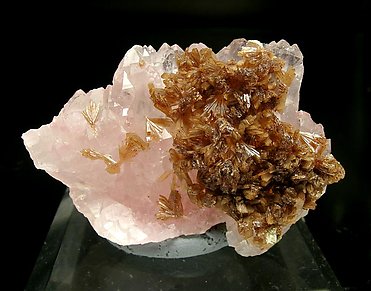
TY27H3: A dense growth of prismatic crystals forming fan groups. Color is very intense. The base is a group of pink crystals of Quartz.
Ilha claim, Taquaral, Itinga, Vale do Jequitinhonha, Minas Gerais Brazil
Specimen size: 4.1 × 2.6 × 1.3 cm = 1.61” × 1.02” × 0.51”
Main crystal size: 0.3 × 0.1 cm = 0.12” × 0.04”
|
|
|
|
Eosphorite on Quartz with Feldspar |
|---|
|
|
TD67H3: The crystals of Eosphorite are prismatic and doubly terminated and are more individualized than usual. The base is a doubly terminated crystal of Smoky Quartz. At one end it is progressively milky and at the opposite end it has a crown of pink crystals. The specimen is completed by a fine white matrix of Feldspar (probably Orthoclase)
Ilha claim, Taquaral, Itinga, Vale do Jequitinhonha, Minas Gerais Brazil
Specimen size: 7.3 × 3.7 × 4 cm = 2.87” × 1.46” × 1.57”
Main crystal size: 0.7 × 0.1 cm = 0.28” × 0.04”
|
| |
|
| Eosphorite with Quartz (variety rose) |
|
|
|
|
|
MR92AL3: Elongated crystals of Eosphorite, many of them doubly terminated, with very well defined crystalline forms and easily visible terminations, transparent, bright, with an intense and uniform brown color with violet shades, on a matrix of crystallized rose Quartz.
Taquaral, Itinga, Vale do Jequitinhonha, Minas Gerais Brazil
Specimen size: 7.9 × 4.9 × 4.1 cm = 3.11” × 1.93” × 1.61”
Main crystal size: 0.7 × 0.1 cm = 0.28” × 0.04”
|
|
|
|
Eosphorite with Quartz, Quartz (variety rose) and Muscovite |
|---|
|
|
MH54R8: A real Brazilian "old timer" (collected in the year 1975), the piece is notable for its aerial growth. On a leafy aggregate of very well defined crystals of Muscovite and flattened white crystals of Quartz, there is a group of pink crystals of Quartz of intense color and luster, all this partially coated by small crystals of Eosphorite, most of them doubly terminated, transparent, bright and with a deep color.
Taquaral, Itinga, Vale do Jequitinhonha, Minas Gerais Brazil (±1975)
Specimen size: 12.7 × 11 × 7.5 cm = 5.00” × 4.33” × 2.95”
|
| |
|
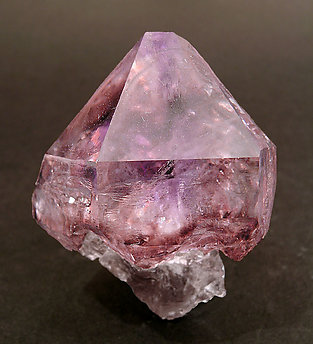
| Quartz (variety amethyst) scepter |
|
 |
|
|
|
TE66G3: The locality is especially interesting and also the specimen. It forms a clear, sharp scepter with inner zones of different intensity of color and attractive inclusions.
The sample has been noted and photographed in the article 'Espirito Santo' of the ‘Mineralogical Record‘ magazine on page 735 in the volume 54, number 6, November-December 2023
Santa Maria do Jetibá, Espirito Santo, Sudeste Region Brazil (12/2004)
Specimen size: 4.5 × 3.5 × 3.2 cm = 1.77” × 1.38” × 1.26”
|
|
|
|
Quartz (variety amethyst) with Calcite |
|---|
Fluorescent light (daylight)
 |
|
|
XM2180NTL: Druse of Quartz (amethyst variety) crystals, on a small matrix of basalt rock. Thick aerial crystals, with very sharp faces and edges and an intense amethyst color, with partial coatings of small Calcite crystals very visible on the back of the piece.
The specimen belonged to Santiago Jiménez who, especially in the 1980s and 90s, assembled an excellent collection.
Rio Grande do Sul Brazil
Specimen size: 8.5 × 7.4 × 7.2 cm = 3.35” × 2.91” × 2.83”
Main crystal size: 3 × 2.7 cm = 1.18” × 1.06”
Calcite minor fluorescence long & short UV
Former collection of Santiago Jiménez García
|
| |
|
| Quartz (variety chalcedony) |
|
|
|
|
|
TR14AM2: Coralloid growth, very aerial and aesthetic, of Quartz, chalcedony variety. Translucent and uniform white in color.
Barra de Salinas, Coronel Murta, Vale do Jequitinhonha, Minas Gerais Brazil
Specimen size: 14.8 × 3.3 × 3.3 cm = 5.83” × 1.30” × 1.30”
Fluorescence short UV & minor fluorescence long UV
|
|
|
It is a new species discovered and accepted by the IMA in the year 2005. It forms different growths, the most usual practically spherical forms, but also donut and empty hemispherical forms. This rare phosphate can be easily confused with another similar, also rare, species. So, we analyzed our samples and we’ll send a copy of the analysis to the buyer. The analytical process also confirmed that in some specimens the matrix is Beryllonite that, furthermore, appears as idiomorphic crystals which adds special interest to the specimen where it is present.
|
Ruifrancoite with Childrenite and Quartz |
|---|
|
|
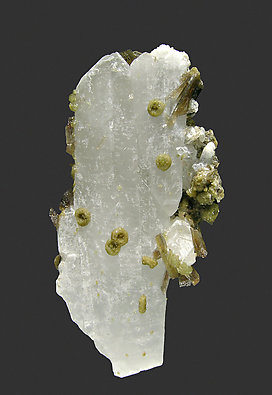
TA11J1: Donut-shaped isolated growths, green colored, on Quartz crystals and prisms of brown Childrenite.
Poço Dantas Mine, Piauí Valley, Taquaral, Itinga, Vale do Jequitinhonha, Minas Gerais Brazil (2006)
Specimen size: 4.9 × 2.7 × 2.6 cm = 1.93” × 1.06” × 1.02”
Main crystal size: 0.2 × 0.2 cm = 0.08” × 0.08”
|
|  |
|
| Ruifrancoite with Beryllonite and Childrenite |
|
|
|
|
|
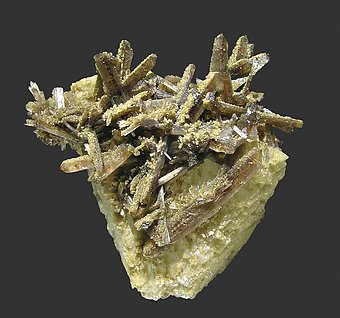
TE11J8: Small groups of yellow crystals that cover and are with brown prismatic crystals of Childrenite, on a matrix of Feldspar and with well-defined crystals of Beryllonite.
Poço Dantas Mine, Piauí Valley, Taquaral, Itinga, Vale do Jequitinhonha, Minas Gerais Brazil (2006)
Specimen size: 5 × 4.3 × 3.4 cm = 1.97” × 1.69” × 1.34”
Main crystal size: 0.1 × 0.1 cm = 0.04” × 0.04”
|
|
|
|
Ruifrancoite on Beryllonite and with Childrenite |
|---|
|
|
TE14J1: Spherical green growths on a white, well-developed, crystal of Beryllonite, and with brown prisms of Childrenite.
Poço Dantas Mine, Piauí Valley, Taquaral, Itinga, Vale do Jequitinhonha, Minas Gerais Brazil (2006)
Specimen size: 5.1 × 4.3 × 2.8 cm = 2.01” × 1.69” × 1.10”
Main crystal size: 0.1 × 0.1 cm = 0.04” × 0.04”
|
| 
Front | 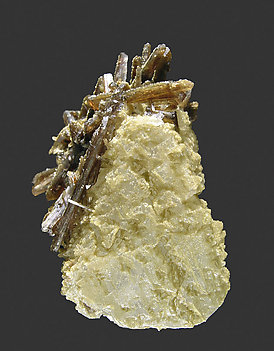
Side |
| |
|
|
The main talking point during the Ste. Marie 2004 show was the new Hematite with Rutile from Novo Horizonte, as it was the first time that they had been seen at a European show and they were a great success. They are spectacular, some of them were on matrix, and the Rutile crystals were thicker, stronger and better terminated than in previous finds means that this find will be talked about for years to come.
We always keep a look out for new material that appears in the mineral world, so this time we were able to carefully select some examples. We looked for ones that that were perfect had had strong Rutile crystals, thus avoiding later problems during shipping.
| Rutile with Hematite |
|
|
|
|
|
MP66AN0: Star-shaped epitaxial growths of Rutile crystals, between acicular and finely prismatic, with very bright luster, yellow color with golden reflections, oriented according to the structure of tabular Hematite crystals.
We will ship the specimen in its original Perky box from the Robert J. Noble collection, which also contains the label.
Novo Horizonte, Bahia State, Northeast Region Brazil
Specimen size: 2.4 × 2.3 × 2.1 cm = 0.94” × 0.91” × 0.83”
Former collection of Bob Noble
|
|
|
|
Hematite with Rutile |
|---|
|
|
MM96AM9: Floater group of Hematite crystals with very well defined faces and edges, lustrous, and with epitaxial growths of flattened Rutile crystals.
We will send the specimen, which comes from the Robert J. Noble collection, in its original Perky box from that collection, which also contains the label, which shows that it was previously in the Frank Melanson collection.
Novo Horizonte, Bahia State, Northeast Region Brazil
Specimen size: 3 × 1.8 × 1.6 cm = 1.18” × 0.71” × 0.63”
Main crystal size: 1.4 × 1 cm = 0.55” × 0.39”
Former collection of Bob Noble
|
| |
|
| Rutile and Hematite |
|
Front | 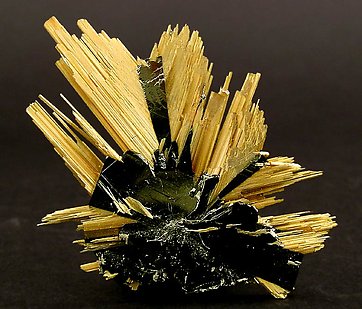
Rear |
| |
|
|
|
|
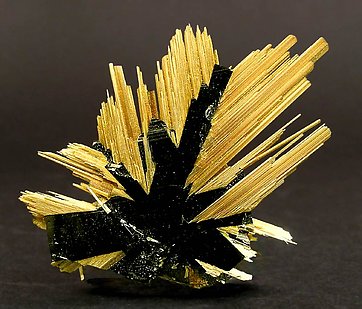
EJ26F4: The crystals of Rutile, which are brilliant yellow and have golden reflections, have grown epitaxially on tabular Hematite. The terminations of the Rutile have very well defined faces, which is not so common with this type of specimen.
The specimen's photo has been reviewed and published in the magazine ‘Rocks & Minerals’ on page 174 in the volume 85, number 2.
Caí bom Mine, Novo Horizonte, Bahia State, Northeast Region Brazil (02/2004)
Specimen size: 2.8 × 2.4 × 0.2 cm = 1.10” × 0.94” × 0.08”
|
|
|
|
Rutile and Hematite |
|---|
|
|
EB46E2: Thick, very brilliant, and perfect crystals of Hematite that formed as a floater and that has a re-crystallized base. The Rutile is growing in the typical orientation on its faces. A really luminous specimen.
Caí bom Mine, Novo Horizonte, Bahia State, Northeast Region Brazil (02/04)
Specimen size: 3.8 × 2.4 × 0.5 cm = 1.50” × 0.94” × 0.20”
|
| 
Front | 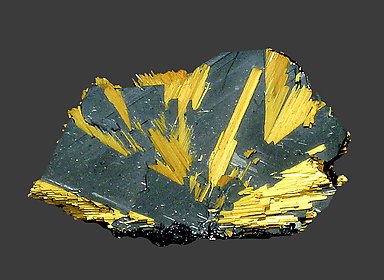
Rear |
| |
|
|
| Rutile and Hematite |
|
|
|
|
|
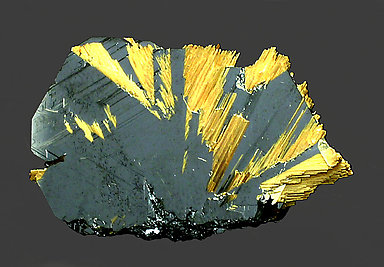
ED86F1: Two crystals of Hematite, as well as some other smaller ones, that form the base for the growth of fine epitaxial prisms of Rutile, which are perfect defined and terminated and have the 60º angles between them that are dictated by the Hematite.
Caí bom Mine, Novo Horizonte, Bahia State, Northeast Region Brazil (02/2004)
Specimen size: 4 × 3.5 × 3 cm = 1.57” × 1.38” × 1.18”
|
|
|
|
Rutile with Hematite |
|---|
|
|
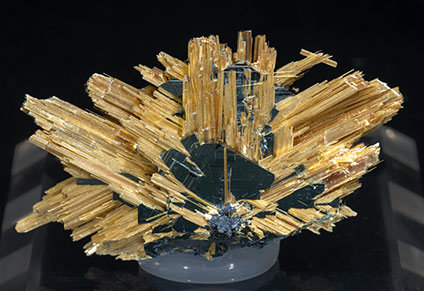
GB52AD4: Epitaxial growths on platy Hematite crystals of thin Rutile crystals with finely striated prismatic faces and good terminations. They have a golden color and are very bright. The sample is from the first finds of this type of Rutile from the locality.
Caí bom Mine, Novo Horizonte, Bahia State, Northeast Region Brazil
Specimen size: 4.5 × 3 × 0.9 cm = 1.77” × 1.18” × 0.35”
Former collection of Pedro Goy
|
| 
Front | 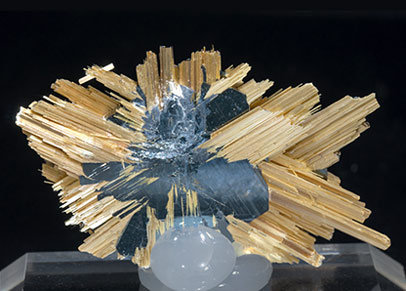
Rear |
| |
|
|
| Rutile with Hematite |
|
|
Fluorescent light (daylight)
|
|
|
|
NFB27AP1: Epitaxial growths of acicular Rutile crystals, with very bright luster and golden reflections, on lamellar crystals of Hematite, and on matrix, something uncommon in this type of specimen.
Caí bom Mine, Novo Horizonte, Bahia State, Northeast Region Brazil (±2007)
Specimen size: 4.6 × 3.4 × 2.7 cm = 1.81” × 1.34” × 1.06”
Main crystal size: 2.7 × 2.3 cm = 1.06” × 0.91”
|
|
|
|
Rutile with Hematite |
|---|
|
|
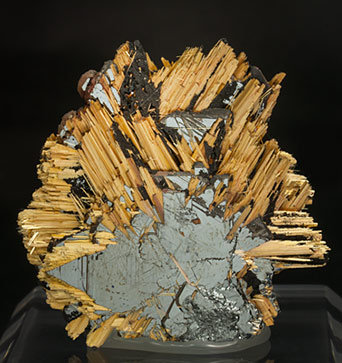
MC69AE6: Epitaxial overgrowths of needlelike rutile crystals on platy Hematite crystals. They have a yellow color with golden reflections, are very bright and have grown oriented in the shape of starbursts following the structure of the tabular Hematite crystal.
Caí bom Mine, Novo Horizonte, Bahia State, Northeast Region Brazil
Specimen size: 4.7 × 4.2 × 2.4 cm = 1.85” × 1.65” × 0.94”
|
| 
Front | 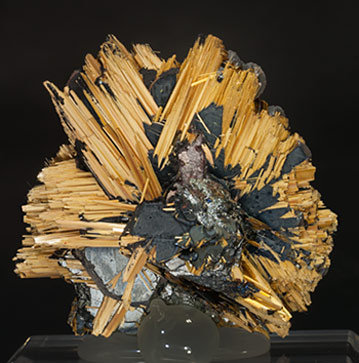
Rear |
| |
|
|
| Rutile with Hematite |
|
 |
Recorded under neon light
|
|
|
|
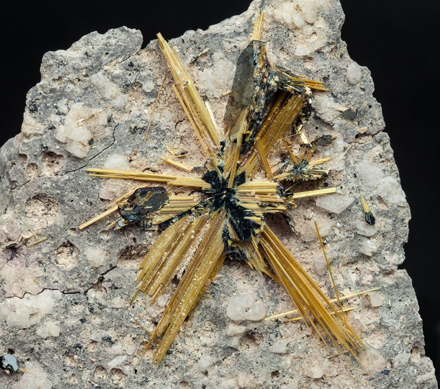
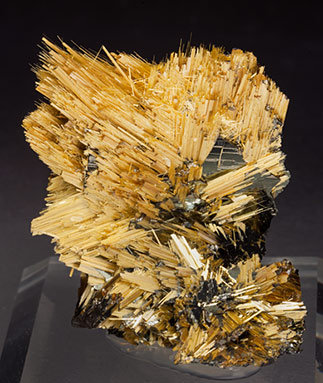
EFF70CDD: We've seen many pieces of this material, but just a few in matrix like this one, and also with the well-defined 'star' of Rutile-Hematite.
Caí bom Mine, Novo Horizonte, Bahia State, Northeast Region Brazil
Specimen size: 4.7 × 4.5 × 1.9 cm = 1.85” × 1.77” × 0.75”
Main crystal size: 2 × 0.1 cm = 0.79” × 0.04”
|
|
|
|
Rutile with Hematite |
|---|
|
|
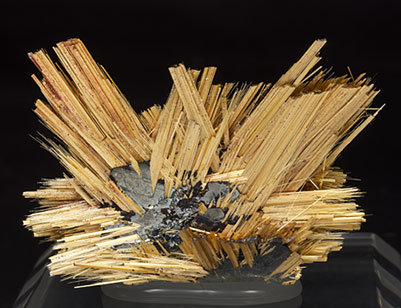
MD69AE6: Epitaxial overgrowths of needlelike rutile crystals on platy Hematite crystals. They have a yellow color with golden reflections, are very bright and have grown oriented in the shape of starbursts following the structure of the tabular Hematite crystal.
Caí bom Mine, Novo Horizonte, Bahia State, Northeast Region Brazil
Specimen size: 4.9 × 3.8 × 1.7 cm = 1.93” × 1.50” × 0.67”
|
| 
Front | 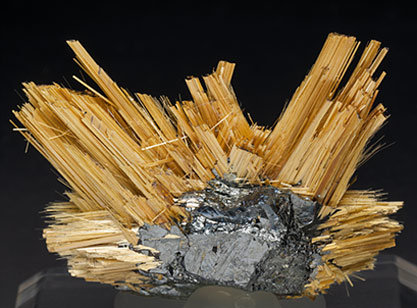
Rear |
| |
|
|
| Rutile with Hematite |
|
Front | 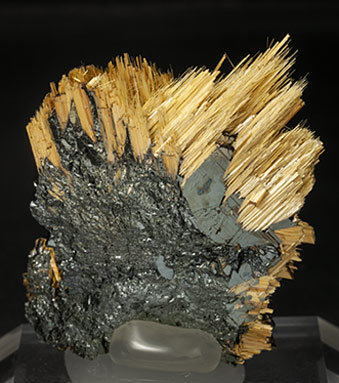
Rear |
| |
|
|
|
|
ME49AE6: Epitaxial overgrowths of needlelike rutile crystals on platy Hematite crystals. They have a yellow color with golden reflections, are very bright and have grown oriented in the shape of starbursts following the structure of the tabular Hematite crystal.
Caí bom Mine, Novo Horizonte, Bahia State, Northeast Region Brazil
Specimen size: 5 × 3.5 × 2.6 cm = 1.97” × 1.38” × 1.02”
|
|
|
From the famous gem Spessartine from Lavra do Navigador we are able to offer these specimens. We selected them primarily for their good transparency, and also when they have brilliant crystals that are well defined. We tried to avoid the ones that have a ‘dissolved’ look, which many of the ones from this find show.
|
Spessartine with Quartz |
|---|
|
|
MD16P6: Floater crystal of very well marked polycrystalline growths, etch dodecahedron faces and with a very small Quartz crystal. Color, luster and
transparency are excellent.
Navegadora claim (Orozimbo claim), Penha do Norte, Conselheiro Pena, Vale do Rio Doce, Minas Gerais Brazil (10-11/2006)
Specimen size: 1.9 × 1.6 × 1.3 cm = 0.75” × 0.63” × 0.51”
Main crystal size: 1.6 × 1.5 cm = 0.63” × 0.59”
|
| 
Front | 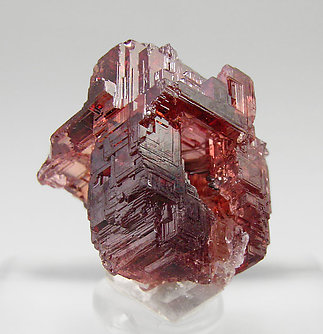
Rear |
| |
|
|
| Spessartine |
|
 |
|
|
|
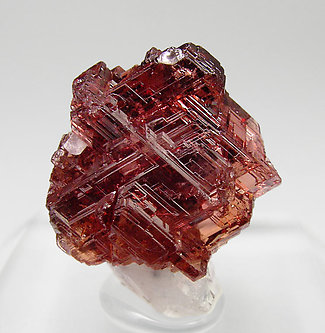
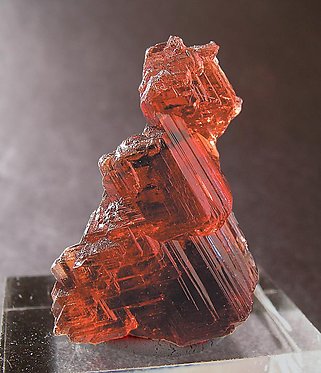
TM66E0:
Navegadora claim (Orozimbo claim), Penha do Norte, Conselheiro Pena, Vale do Rio Doce, Minas Gerais Brazil (2003)
Specimen size: 2.6 × 1.7 × 0.7 cm = 1.02” × 0.67” × 0.28”
|
|
|
|
Spessartine |
|---|
|
|
TV68Q8: A floater flattened dodecahedral crystal with parallel faces due to etching typical for the specimens from this locality. The crystal is transparent and has a very deep and uniform color that acquires a special quality under an intense light.
Navegadora claim (Orozimbo claim), Penha do Norte, Conselheiro Pena, Vale do Rio Doce, Minas Gerais Brazil (10-11/2006)
Specimen size: 4 × 2.7 × 1.9 cm = 1.57” × 1.06” × 0.75”
|
| |
|
| Spessartine with Albite |
|
|
|
|
|
TM36D8: From the famous find of gem Spessartine from Lavra do Navegadora we obtained this enormous crystal that shows of all the great features of the find. Intense color, great transparency, a floater, complete and with dissolution marks on its faces. In this piece, just to add to everything else, the brilliance is extraordinary and, even though it is quite thick, the gem quality of the crystal is very visible when lit from the front and spectacular when lit from the rear. There is a little bit of Albite on this powerful specimen.
Navegadora claim (Orozimbo claim), Penha do Norte, Conselheiro Pena, Vale do Rio Doce, Minas Gerais Brazil (2003)
Specimen size: 6.2 × 4.7 × 3.5 cm = 2.44” × 1.85” × 1.38”
|
|
|
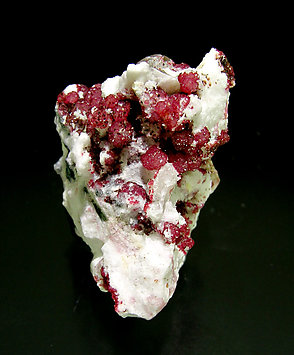
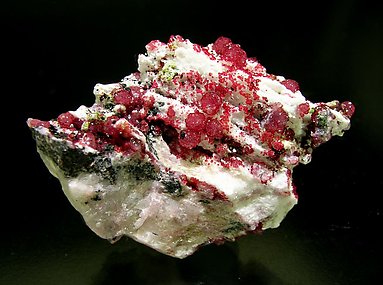
The color of these Variscites is extraordinary, deep red, and especially unusual for the species, placing them among the best known.
Analysis indicate these Variscites are slightly ferroan (which is normal considering that Al and Fe form a series). We think, however, its color is not due to iron because the center of crystals is almost uncolored but the external zone is deeply colored yet both zones have the same chemical composition. Considering all this we think the red color may be due to color centers as is the case of some zoned Fluorites.
As we normally do in these cases we will send the buyer a copy of the analysis.
|
Variscite |
|---|
|
|
EK6H6: Crystals and spheroidal groups have very intense color and luster. They occupy the vugs on the sample and contrast with the matrix, clearer in some zones and darker in others.
The specimen has been reviewed, photographed and published as a new discovery in the magazine ‘Mineralogical Record’ on page 481 in the volume 37, number 5.
Boa Vista (Eduardo) Mine, Conselheiro Pena, Vale do Rio Doce, Minas Gerais Brazil (2006)
Specimen size: 2.1 × 1.5 × 1.8 cm = 0.83” × 0.59” × 0.71”
|
| 
Front | 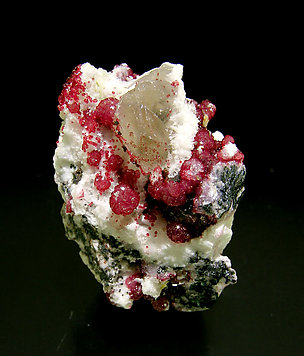
Rear |
| |
|
|
| Variscite |
|
Front | 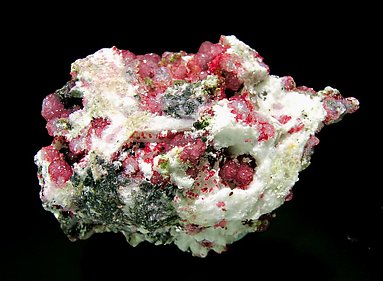
Rear |
| |
|
|
|
|
EG12H6: Crystals and spheroidal groups have very intense color and luster. They occupy the vugs on the sample and contrast with the matrix, clearer in some zones and darker in others.
Boa Vista (Eduardo) Mine, Conselheiro Pena, Vale do Rio Doce, Minas Gerais Brazil (2006)
Specimen size: 3.2 × 2.3 × 1.7 cm = 1.26” × 0.91” × 0.67”
|
|
|
|
Variscite with Albite and Rockbridgeite |
|---|
|
|
TC90TC: Spheroidal aggregates of Variscite, one of them clearly dominant, with good luster and an intense and uniform pink color, something uncommon in the species. They sit on an Albite matrix with small Rockbridgeite coatings. The specimen has been analyzed and we will send a copy of the analysis to the buyer.
Boa Vista (Eduardo) Mine, Conselheiro Pena, Vale do Rio Doce, Minas Gerais Brazil (2006)
Specimen size: 9.5 × 9 × 4.6 cm = 3.74” × 3.54” × 1.81”
Main crystal size: 0.5 × 0.4 cm = 0.20” × 0.16”
Analyzed
|
| |
|
| Strengite |
|
 |
|
|
|
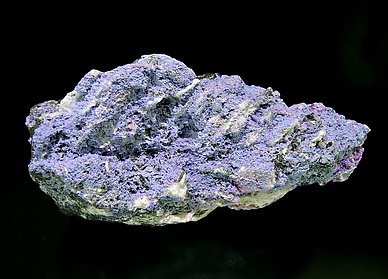
TR9H6: The sample is very rich with purlish Strengite concretions that occupy nearly all the specimen volume. Locally there are some small rows of Variscite crystals.
We’ll give a copy of the Strengite analysis to the buyer.
Boa Vista (Eduardo) Mine, Conselheiro Pena, Vale do Rio Doce, Minas Gerais Brazil (2006)
Specimen size: 6.6 × 3.4 × 3.8 cm = 2.60” × 1.34” × 1.50”
|
|
|
|
Zanazziite on Quartz (variety rose quartz) |
|---|
Fluorescent light (daylight)
|
|
|
EBP66AP3: Spheroidal aggregates of Zanazziite microcrystals with a greenish brown color on a group of Quartz crystals (pink quartz variety) that has grown on an isolated crystal of white Quartz.
This specimen comes from the type locality for the species.
Ilha claim, Taquaral, Itinga, Vale do Jequitinhonha, Minas Gerais Brazil
Specimen size: 4.6 × 2.6 × 1.6 cm = 1.81” × 1.02” × 0.63”
Main crystal size: 0.1 × 0.1 cm = 0.04” × 0.04”
Type locality
Analyzed
|
| |
|
| Zanazziite with Muscovite and Quartz |
|
|
|
|
|
TF27AM7: Coatings of many small salmon-colored Zanazziite crystals with good luster, on a Muscovite matrix with Quartz crystals.
Murundu Mine, Jenipapo District, Itinga, Vale do Jequitinhonha, Minas Gerais Brazil
Specimen size: 9.4 × 7.2 × 4.7 cm = 3.70” × 2.83” × 1.85”
Main crystal size: 0.1 × 0.1 cm = 0.04” × 0.04”
|
|
|
|
Zanazziite with Elbaite and Microcline |
|---|
Fluorescent light (daylight)
|
|
|
TFR96AO4: Spheroidal aggregates of Zanazziite microcrystals, a rare phosphate of calcium, magnesium and beryllium, translucent, lustrous, and light cream in color. On matrix with Elbaite crystals and small Microcline coatings.
Ponte do Piauí Mine, Piauí Valley, Taquaral, Itinga, Vale do Jequitinhonha, Minas Gerais Brazil
Specimen size: 9.9 × 4.6 × 3.7 cm = 3.90” × 1.81” × 1.46”
|
| |
|
| Zanazziite (manganoan) with Kosnarite and Albite |
|
|
|
|
|
TK6K9: On the same specimen there are two very rare species. Beige crystals of Kosnarite with pinkish, radial aggregates of Zanazziite, on white Albite matrix. The Zanazziite has been carefully analyzed and the result is surprising: iron is nearly replaced by manganese (thus its pinkish shade), so we present it as manganoan Zanazziite. Matrix is Albite. We’ll send a copy of the analysis to the buyer.
Jenipapo District, Itinga, Vale do Jequitinhonha, Minas Gerais Brazil (2002-2003)
Specimen size: 4.6 × 1.9 × 2.2 cm = 1.81” × 0.75” × 0.87”
Main crystal size: 0.1 × 0.1 cm = 0.04” × 0.04”
Analyzed
Minor fluorescence UV short wave
|
|
|
|
Zanazziite (manganoan) with Kosnarite and Albite |
|---|
|
|
TE96H4: On the same specimen there are two very rare species. Kosnarite in pseudo-octahedral, creamy, crystals with very sharp and bright faces and edges. The Zanazziite has been carefully analyzed and the result is surprising: iron is nearly replaced by manganese (thus its pinkish shade), so we present it as manganoan Zanazziite. Matrix is Albite. We’ll send a copy of the analysis to the buyer.
Jenipapo District, Itinga, Vale do Jequitinhonha, Minas Gerais Brazil (2002-2003)
Specimen size: 6.4 × 5.6 × 6.1 cm = 2.52” × 2.20” × 2.40”
Main crystal size: 0.1 × 0.1 cm = 0.04” × 0.04”
Fluorescent short UV
|
| |
|
| Zanazziite (manganoan) with Albite and Elbaite |
|
|
|
|
|
TG46AM5: Polycrystalline radial aggregates of Zanazziite, a rare phosphate of calcium, magnesium, and beryllium, translucent and pink and on an Albite matrix with Elbaite crystals. The analysis, of which we will send a copy to the buyer, shows an almost complete substitution of manganese for the normal subordinate iron, which is why we call it manganese-rich Zanazziite.
Jenipapo District, Itinga, Vale do Jequitinhonha, Minas Gerais Brazil (2002-2003)
Specimen size: 6.9 × 5.4 × 4.2 cm = 2.72” × 2.13” × 1.65”
Main crystal size: 0.1 × 0.1 cm = 0.04” × 0.04”
|
|
|





 Next Page


