Reference Specimens
Joaquim Callen's Photo Gallery

(para ver esta página en español)

Previous Page Previous Page Next Page Next Page

  Back to the Index of the Reference Specimens Page bottom

Photos by Fabre Minerals. Under Creative Commons license

This page provides a selection of the specimens from the Joaquim Callen's Photo Gallery that have passed through the Fabre Minerals website and, due to their quality,
rarity, or significance as specimens from interesting locations, have been preserved as reference specimens in #MVM

Jordi Fabre Text: Jordi Fabre (Fabre Minerals)
Assistance from John S. White (former Smithsonian curator) John S. White


When Jordi offered me a corner on his web page to publish photos of the pieces that I choose I found it an excellent idea. It goes without saying that the project made me very enthusiastic immediately.

It is my intention to show, through my photographs, my point of view of the beauty of minerals, and I hope to add to that a point of charm, that touch of magic that minerals awaken in all those who view them with delight and admiration.

Joaquim Callén

Joaquim Callén

If you want to know how this special
page works do click on the image


Joaquim Callen's Photo Gallery


USA

Wulfenite  


Wulfenite  
Wulfenite. Wulfenite.
Wulfenite.

NT89AJ6
Typically from the classic Red Cloud mine the tabular crystals are very sharp and are implanted on a limonite matrix, showing all of their splendor and beauty with the perfection of the crystal forms and the intensity of their bright red color. The sample is from the Ignacio Hernández collection whose label we will send to the buyer.


Red Cloud Mine, Trigo Mountains, Silver mining District, La Paz County, Arizona
USA


Former collection of Ignacio Hernández

Specimen size: 8.7 × 5.1 × 2.5 cm = 3.43” × 2.01” × 0.98”

Main crystal size: 1.6 × 1 cm = 0.63” × 0.39”


  Rhodochrosite

Anselmo Mine, Butte, Butte District, Silver Bow County, Montana
USA


Specimen size: 4.8 × 4.1 × 3 cm = 1.89” × 1.61” × 1.18”

Main crystal size: 1.7 × 1.2 cm = 0.67” × 0.47”

Rhodochrosite. Rhodochrosite.

TM91AG1
An American classic coming from a mainly forgotten mine, the Anselmo mine. The crystals are almost completely covered by a thin crust of Quartz but in some places where there is no Quartz you can see their excellent color.

 
  Rhodochrosite

Elbaite  


Elbaite  
Elbaite. Elbaite.

TV88AJ6
Of the polychrome Elbaites from the Himalaya mine one of the characteristics that the 'photographic eye' most appreciates is the geometric color zoning, in this case from the bottom to the top there are three superimposed delicate pastel colors: yellow, pink and green. A 'delicatessen'. We will send the sample in its original Perkin’s box from the R.J. Noble collection, also with the collection label on which it appears that it was obtained in an exchange with Terry Enright, June 2011.


Himalaya Mine, Gem Hill, Mesa Grande District, San Diego County, California
USA


Former collection of Bob Noble

Specimen size: 2.7 × 1.1 × 1.1 cm = 1.06” × 0.43” × 0.43”


  Beryl (variety morganite) with Muscovite

Elizabeth R. Mine, Chief Mountain, Pala, Pala District, San Diego County, California
USA


Specimen size: 3.6 × 3.4 × 2.3 cm = 1.42” × 1.34” × 0.91”

Beryl (variety morganite) with Muscovite. Front
Front
Beryl (variety morganite) with Muscovite. Front
Front
Beryl (variety morganite) with Muscovite. Side
Side
Beryl (variety morganite) with Muscovite. Side
Side

TG91AG1
Very good geometry, a floater, doubly terminated and with a white phantom inside. Its color is not very intense but I like classics, and for obvious reasons I like this classic.

 
  Beryl (variety morganite) with Muscovite


Mexico

Boleite with Atacamite-Paratacamite  


Boleite with Atacamite-Paratacamite  
Boleite with Atacamite-Paratacamite. Boleite with Atacamite-Paratacamite.

TE87AG1
Boleite with Atacamite-Paratacamite on matrix. Coming from recent finds in the famous Amelia Mine due to work on the dumps there.


Amelia Mine, Arroyo de la Soledad, Boleo mining district, Santa Rosalía (El Boleo), Municipio Mulegé, Baja California Sur
Mexico


Specimen size: 7 × 5 × 4.8 cm = 2.76” × 1.97” × 1.89”

Main crystal size: 0.7 × 0.6 cm = 0.28” × 0.24”


  Rhodochrosite with Hisingerite-Neotocite (Series)

Potosí Mine, Santo Domingo (Francisco Portillo), Santa Eulalia District, Municipio Aquiles Serdán, Chihuahua
Mexico


Specimen size: 7.9 × 5.2 × 4 cm = 3.11” × 2.05” × 1.57”

Rhodochrosite with Hisingerite-Neotocite (Series). Front / Photo: Joaquim Callén
Front / Photo: Joaquim Callén
Rhodochrosite with Hisingerite-Neotocite (Series). Rear / Photo: Joaquim Callén
Rear / Photo: Joaquim Callén
Rhodochrosite with Hisingerite-Neotocite (Series). Detail / Photo: Joaquim Callén
Detail / Photo: Joaquim Callén

EMA89AN8
Botryoidal growths of small rhombohedral Rhodochrosite crystals, with very good luster and an a vivid and uniform pink color, covering a botryoidal Hisingerite-Neotocite (Series) matrix. It should be noted that there is a second generation of smaller Hisingerites dotting the botryoidal Rhodochrosite crystals.


Fluorescent light (daylight)
Rhodochrosite with Hisingerite-Neotocite (Series)

Fluorite (octahedral)  


Fluorite (octahedral)  
Fluorite (octahedral). Fluorite (octahedral).

TQ51AG1
Creedites are well known from this mine, but their Fluorites are not as well known and yet they are excellent; octahedral and violet and more rarely in very large crystals such as this one. On a base of Quartz and a first generation of green Fluorite, the collector José Luis Vallecillo was right in his choice of this powerful Fluorite.


Navidad Mine, Abasolo, Rodeo, Rodeo Municipality, Durango
Mexico


Former collection of José Luis Vallecillo

Specimen size: 15.8 × 13.5 × 5.7 cm = 6.22” × 5.31” × 2.24”

Main crystal size: 4.8 × 4.2 cm = 1.89” × 1.65”


  Quartz (variety amethyst)

Amatitlán, Municipio Eduardo Neri, Guerrero
Mexico


Former collection of José Luis Vallecillo

Specimen size: 17.7 × 11.5 × 6.7 cm = 6.97” × 4.53” × 2.64”

Main crystal size: 6 × 1.7 cm = 2.36” × 0.67”

Quartz (variety amethyst). Quartz (variety amethyst).
Quartz (variety amethyst).

TB91AG1
Large crystals of amethyst, different than the classic amethysts of Las Vigas, with thicker and slightly tapered crystals and zoned color, very intense in the first generation of the crystal and colorless or white in its last growth phase. A classic of the past from the collection of José Luis Vallecillo.

 
  Quartz (variety amethyst)

Azurite  


Azurite  
Azurite. Front
Front
Azurite. Side
Side
Azurite. Side
Side

TA68AG2
"Electric blue" is the proper name that has been given to the color of the best Azurites from Milpillas. Certainly these Azurites seem to have their own light as if they emit light instead of capturing it. This small filigree represents very well that "electric" color as well as the best quality of the Milpillas Azurites.


Milpillas Mine, Milpillas (Cuitaca), Municipio Santa Cruz, Sonora
Mexico

12/2013


Specimen size: 4.2 × 2.9 × 2.3 cm = 1.65” × 1.14” × 0.91”

Main crystal size: 2.6 × 1.2 cm = 1.02” × 0.47”


  Brochantite

Milpillas Mine, Milpillas (Cuitaca), Municipio Santa Cruz, Sonora
Mexico

2012


Specimen size: 5.2 × 4.5 × 4.6 cm = 2.05” × 1.77” × 1.81”

Main crystal size: 0.9 × 0.8 cm = 0.35” × 0.31”

Brochantite. Brochantite.

TL62AI9
Brochantite crystals from Milpillas are famous for their sharpness and generally excellent quality. Here we have a group of idiomorphic Brochantite crystals with well-defined faces and edges and chisel-like terminations. The specimen’s composition, with large crystals on matrix coated by smaller crystals, makes for fine aesthetics. In my opinion this locality produces the world’s finest Brochantite specimens.

 
  Brochantite

Brochantite  


Brochantite  
Brochantite. Brochantite.

TR88AI9
Brochantite specimens from Milpillas have won a well-deserved fame for their excellent quality. In this case, the idiomorphic crystals are elongated,with sharp faces and edges and a very deep green color; the matrix is partially coated by a later generation of brochantite, showing pale green fibrous crystals with satiny luster. In my opinion this locality offers the world’s best Brochantite as judged by crystal size and sharpness, deep color and high luster.


Milpillas Mine, Milpillas (Cuitaca), Municipio Santa Cruz, Sonora
Mexico

01/2015


Specimen size: 6.2 × 5.4 × 2.6 cm = 2.44” × 2.13” × 1.02”

Main crystal size: 1 × 0.3 cm = 0.39” × 0.12”


  Brochantite

Milpillas Mine, Milpillas (Cuitaca), Municipio Santa Cruz, Sonora
Mexico

2013


Specimen size: 7.7 × 5.6 × 2.5 cm = 3.03” × 2.20” × 0.98”

Brochantite. Brochantite.
Brochantite.

TA70AG2
Most of the mineral species that the Milpillas mine has produced are the best of the best. The Brochantites are part of this rating and this piece is a good example of it for its excellent color, its richness of crystals, and the fact that the crystals are on a rock matrix.

 
  Brochantite

Cuprite  


Fluorescent light (daylight)
Cuprite
 
Cuprite. Front / Photo: Joaquim Callén
Front / Photo: Joaquim Callén
Cuprite. Front with incident light / Photo: Joaquim Callén
Front with incident light / Photo: Joaquim Callén
Cuprite. Detail / Photo: Joaquim Callén
Detail / Photo: Joaquim Callén

TMA70AN8
Cuprite crystals formed by the dominant octahedron and cube, beveled by rhombic-dodecahedron faces, with some window growths and with very well defined faces and edges. The crystals, on a rock matrix, are translucent and have a very deep red color, partially masked by their extraordinary luster.


Milpillas Mine, Milpillas (Cuitaca), Municipio Santa Cruz, Sonora
Mexico

08-09/2015


Specimen size: 6.3 × 4.4 × 4.4 cm = 2.48” × 1.73” × 1.73”

Main crystal size: 0.7 × 0.6 cm = 0.28” × 0.24”


  Cuprite

Milpillas Mine, Milpillas (Cuitaca), Municipio Santa Cruz, Sonora
Mexico

2015


Specimen size: 8.7 × 8 × 4.8 cm = 3.43” × 3.15” × 1.89”

Main crystal size: 1 × 0.8 cm = 0.39” × 0.31”

Cuprite. Cuprite.
Cuprite.

TA30AG1
Milpillas is in recent times a kind of lighthouse for the fans of minerals from all over the world. Within the extensive catalog of spectacular minerals their Cuprites are not the most recognized, but their quality is very high.

 
  Cuprite

Malachite after Azurite  


Malachite after Azurite  
Malachite after Azurite. Front
Front
Malachite after Azurite. Rear
Rear

TP16AI9
Pseudocrystals of Malachite after Azurite in parallel growth on a matrix of fibrous Malachite: bright, with very rich color.


Milpillas Mine, Milpillas (Cuitaca), Municipio Santa Cruz, Sonora
Mexico

2009


Specimen size: 3.4 × 3 × 2 cm = 1.34” × 1.18” × 0.79”


  Doubly terminated Malachite after Azurite

Milpillas Mine, Milpillas (Cuitaca), Municipio Santa Cruz, Sonora
Mexico

2009


Specimen size: 4.2 × 2.3 × 1.9 cm = 1.65” × 0.91” × 0.75”

Doubly terminated Malachite after Azurite. Front
Front
Doubly terminated Malachite after Azurite. Side
Side

TH16AI9
This is a single, sharp, doubly terminated floater of Malachite pseudomorphous after Azurite, apparently simple, but the polycrystalline growths are full of interesting details.

 
  Doubly terminated Malachite after Azurite

Malachite after Azurite  


Fluorescent light (daylight)
Malachite after Azurite
 
Malachite after Azurite. Front
Front
Malachite after Azurite. Side
Side
Malachite after Azurite. Rear
Rear

TG99AI9
This is a group of pseudocrystals of Malachite after Azurite, one of them clearly dominant, with very well-defined faces and edges and a very deep color, partially coated by fibrous Malachite.


Milpillas Mine, Milpillas (Cuitaca), Municipio Santa Cruz, Sonora
Mexico

2009


Specimen size: 9.1 × 5.8 × 5.3 cm = 3.58” × 2.28” × 2.09”

Main crystal size: 5.4 × 3.1 cm = 2.13” × 1.22”


  Volborthite

Milpillas Mine, level 26, Milpillas (Cuitaca), Municipio Santa Cruz, Sonora
Mexico

04/2015


Specimen size: 1.3 × 1.3 × 0.7 cm = 0.51” × 0.51” × 0.28”

Volborthite. Volborthite.

EK57AI9
Milpillas Volborthite specimens are without doubt the world’s best: with their large crystal size and high luster they set a new standard for this rare species. This small specimen shows a rosette-shaped growth of flattened Volborthite crystals on matrix; the rosette is very sharp and deeply colored.
The sample has been noted and photographed in the monograph 'The Milpillas Mine' of the ‘Mineralogical Record‘ magazine on page 619 in the volume 52, number 5, September-October 2021

 
  Volborthite

Pyrite with Calcite  


Pyrite with Calcite  
Pyrite with Calcite.

TE37AI9
A floater group of pyritohedral crystals without minor forms, with very well-defined faces and edges, very bright and partially coated by growths of calcite microcrystals. The specimen is from a locality where good Pyrite specimens are not so common.


Concepción del Oro, Municipio Concepción del Oro, Zacatecas
Mexico


Calcite fluorescent long & short UV

Specimen size: 7.5 × 6.2 × 3.7 cm = 2.95” × 2.44” × 1.46”

Main crystal size: 1.4 × 1.2 cm = 0.55” × 0.47”


Spain

  Cerussite after Anglesite on Goethite

San Valentín open pit, Sancti Espíritu, Sierra Minera de Cartagena-La Unión, La Unión, Comarca Campo de Cartagena, Region of Murcia (Murcia)
Spain


Fluorescent long & short UV

Specimen size: 9.3 × 8.4 × 5 cm = 3.66” × 3.31” × 1.97”

Main crystal size: 2 × 0.6 cm = 0.79” × 0.24”

Cerussite after Anglesite on Goethite. Front / Photo: Joaquim Callén
Front / Photo: Joaquim Callén
Cerussite after Anglesite on Goethite. Detail / Photo: Joaquim Callén
Detail / Photo: Joaquim Callén

NTV91AN8
Group of very sharp Anglesite crystals pseudomorphed by Cerussite and covered by Goethite which is dominated by iridescence of gold, mauve and blue tones, on matrix,
The specimen, of high quality for the locality, comes from the Miguel David Martínez collection (number 897), whose label we will send to the buyer.


Fluorescent light (daylight)
Cerussite after Anglesite on Goethite

Cerussite on Goethite  


Fluorescent light (daylight)
Cerussite on Goethite
 
Cerussite on Goethite. Front / Photo: Joaquim Callén
Front / Photo: Joaquim Callén
Cerussite on Goethite. Detail / Photo: Joaquim Callén
Detail / Photo: Joaquim Callén

NRF89AN8
Cyclic twins of second generation yellowish white tabular crystals of Cerussite, with very sharp and translucent crystal forms that contrast with the Goethite matrix that presents low iridescence with mostly reddish brown colors.
This specimen comes from the Miguel David Martínez collection (number 822), whose label we will send to the buyer.


San Valentín open pit, Sancti Espíritu, Sierra Minera de Cartagena-La Unión, La Unión, Comarca Campo de Cartagena, Region of Murcia (Murcia)
Spain

±1995


Fluorescent long & short UV

Specimen size: 12 × 7.3 × 8.5 cm = 4.72” × 2.87” × 3.35”

Main crystal size: 0.5 × 0.4 cm = 0.20” × 0.16”


  Dolomite

Asturreta Quarry, 'El pozo', Eugui, Esteríbar, Comarca Auńamendi, Chartered Community of Navarre (Navarre)
Spain

±1970


Former collection of Lluís Daunis

Specimen size: 7.2 × 6.5 × 5.2 cm = 2.83” × 2.56” × 2.05”

Main crystal size: 4.2 × 3.5 cm = 1.65” × 1.38”

Dolomite. Front
Front
Dolomite. Side
Side
Dolomite. Side
Side

DP16AG6
The Daunis collection is a faithful mirror of the minerals that were found in Spain in the 60’s and 70’s. The Asturreta Quarry, specifically the area called "El Pozo," produced in those years the best known Dolomites and Daunis had the ability to get some of them of extraordinary quality. This piece is a good example.

 
  Dolomite


Portugal

Fluorapatite with Quartz and Muscovite  


Fluorapatite with Quartz and Muscovite  
Fluorapatite with Quartz and Muscovite. Front
Front
Fluorapatite with Quartz and Muscovite. Side
Side
Fluorapatite with Quartz and Muscovite. Fluorapatite with Quartz and Muscovite.

NP90AG2
The upper levels of the great classic mine of Panasqueira are now producing very good specimens. We have gone from a period of scarcity to the current wealth, but in my opinion we are in a transitory period that may end when the mine goes to different areas. So far several pieces as attractive as this zoned crystal of Fluorapatite have been recovered, isolated and well placed on its matrix of Quartz and Muscovite.


Minas da Panasqueira, levels 0-1, Aldeia de Săo Francisco de Assis, Covilhă Municipality, Castelo Branco District
Portugal

04/2017


Fluorescent long & short UV

Specimen size: 10.7 × 5.6 × 4.5 cm = 4.21” × 2.20” × 1.77”

Main crystal size: 3.7 × 3.6 cm = 1.46” × 1.42”


  Fluorite with Quartz, Siderite and Calcite

Minas da Panasqueira, Aldeia de Săo Francisco de Assis, Covilhă Municipality, Castelo Branco District
Portugal

06/2021


Specimen size: 25.5 × 9.3 × 9.2 cm = 10.04” × 3.66” × 3.62”

Main crystal size: 0.5 × 0.5 cm = 0.20” × 0.20”

Fluorite with Quartz, Siderite and Calcite. Front / Photo: Joaquim Callén
Front / Photo: Joaquim Callén
Fluorite with Quartz, Siderite and Calcite. Side / Photo: Joaquim Callén
Side / Photo: Joaquim Callén
Fluorite with Quartz, Siderite and Calcite. Detail / Photo: Joaquim Callén
Detail / Photo: Joaquim Callén

NBA26AN8
Cubic crystals of Fluorite beveled by the rhombo-dodecahedron, translucent and with an intense bluish lilac color, on a Quartz crystal dotted with small cream-colored crystals of Siderite with hexagonal contour, both on the Quartz crystal and on the Fluorite crystals, a fact that shows that a carbonate, in this case Siderite, was the last mineral to form. Different.


Fluorescent light (daylight)
Fluorite with Quartz, Siderite and Calcite


France

Quartz (variety smoky) with Epidote  


Quartz (variety smoky) with Epidote  
Quartz (variety smoky) with Epidote. Front
Front
Quartz (variety smoky) with Epidote. Side
Side

LK91AK2
A good example of what is expected of an Alpine fissure Smoky Quartz, for its transparency, intense luster and depth of color. Associated with some small Epidote crystals. The sample is from the Philippe Morelon collection (No. 766), whose catalogue entry we will send to the buyer.


Pointe des Périades, Mont Blanc Massif, Chamonix, Haute-Savoie, Auvergne-Rhône-Alpes
France

07/2010


Former collection of Philippe Morelon

Specimen size: 10.9 × 9.7 × 9.2 cm = 4.29” × 3.82” × 3.62”

Main crystal size: 8.4 × 5.3 cm = 3.31” × 2.09”


  Quartz with inclusions

Ŕ Giraud Mine, La Gardette mining area, Villard-Nôtre-Dame, Le Bourg d'Oisans, Grenoble, Isčre, Auvergne-Rhône-Alpes
France

2013


Former collection of Philippe Morelon

Specimen size: 8.2 × 7.3 × 5.7 cm = 3.23” × 2.87” × 2.24”

Main crystal size: 4.2 × 1 cm = 1.65” × 0.39”

Quartz with inclusions. Front
Front
Quartz with inclusions. Rear
Rear
Quartz with inclusions.

LE70AK2
This specimen, extraordinarily fine and elegant and very well balanced, displays a group of Quartz crystals, on matrix, with a well defined La Gardette habit, elongated, transparent, colorless, very bright and with small inclusions. The sample, a French classic, comes from the Philippe Morelon collection (No. 1107), whose catalogue entry we will send to the buyer.

 
  Quartz with inclusions

Sphalerite with Calcite and Dolomite  


Sphalerite with Calcite and Dolomite  
Sphalerite with Calcite and Dolomite. Sphalerite with Calcite and Dolomite.

LT70AK2
The specimen is a perfect aesthetic compendium of Sphalerite, with complex crystals, one of them clearly dominant and very aerial, of unusual size for the locality, with distinct polycrystalline growths and with curvatures on the faces and edge, translucent, lustrous and rich in deep and intense color tones. On matrix, with Dolomite and white rhombohedral crystals of Calcite. The specimen is from the Philippe Morelon collection (No. 1075), whose catalogue entry we will send to the buyer.


La Mure area, La Mure, Matheysine-Tričves, Grenoble, Isčre, Auvergne-Rhône-Alpes
France

±1996


Former collection of Philippe Morelon

Specimen size: 4.7 × 4.6 × 2.8 cm = 1.85” × 1.81” × 1.10”

Main crystal size: 2 × 2 cm = 0.79” × 0.79”


  Sphalerite with Bournonite and Siderite

Le Villaret pit, Susville, Matheysine-Tričves, Grenoble, Isčre, Auvergne-Rhône-Alpes
France

1976


Former collection of Alain Martaud

Specimen size: 8.7 × 7.3 × 4.5 cm = 3.43” × 2.87” × 1.77”

Main crystal size: 2 × 0.7 cm = 0.79” × 0.28”

Sphalerite with Bournonite and Siderite. Front / Photo: Joaquim Callén
Front / Photo: Joaquim Callén
Sphalerite with Bournonite and Siderite. Detail / Photo: Joaquim Callén
Detail / Photo: Joaquim Callén
Sphalerite with Bournonite and Siderite. Detail / Photo: Joaquim Callén
Detail / Photo: Joaquim Callén

EXT96AN8
Group of complex equant crystals of Sphalerite, very transparent and lustrous, with an intense color and a lively interior "fire". Large for the deposit and on a matrix of lenticular crystals of Siderite with a very light cream color, and twinned Bournonite crystals.
This specimen comes from the Alain Martaud collection, whose label we will send to the buyer.
The specimen has been photographed and published in the magazine ‘Paragénesis’, number 02/2021, page 100


Fluorescent light (daylight)
Sphalerite with Bournonite and Siderite

Quartz (Variety faden quartz)  


Quartz (Variety faden quartz)  
Quartz (Variety faden quartz). Front
Front
Quartz (Variety faden quartz). Rear
Rear

LW89AK2
An excellent example of Alpine-type quartz with a very visible faden cord and that has formed a flattened parallel growth floater, extraordinarily sharp, of colorless, transparent and very brilliant crystals. The specimen is from the Philippe Morelon collection (No. 351), whose catalogue entry we will send to the buyer.


Col de la Valette, Besse, Oisans-Romanche, Grenoble, Isčre, Auvergne-Rhône-Alpes
France

08/2001


Former collection of Philippe Morelon

Specimen size: 10.1 × 3.7 × 1.1 cm = 3.98” × 1.46” × 0.43”


  Azurite with Malachite after Cuprite

Chessy mines, Chessy-les-Mines, Villefranche-sur-Saône, Rhône, Auvergne-Rhône-Alpes
France

2005-2009


Type locality

Specimen size: 3.7 × 3.2 × 2.4 cm = 1.46” × 1.26” × 0.94”

Main crystal size: 1.1 × 1 cm = 0.43” × 0.39”

Azurite with Malachite after Cuprite. Azurite with Malachite after Cuprite.

EE57AJ6
A classic aggregate of Malachite crystals after Cuprite, formed by the cube and the dodecahedron. Its clear and uniform green color contrasts with the deep blue of the nodule of equant Azurite crystals. A French classic.

 
  Azurite with Malachite after Cuprite

Quartz  


Quartz  
Quartz. Front
Front
Quartz. Rear
Rear

TE26AG1
La Gardette is a mythical name. That small mine located in the middle of the French Alps has offered and continues to offer some of the most elegant Quartzes in the world. A beauty as fascinating as the place where they are found.


La Gardette Mine, La Gardette mining area, Villard-Notre-Dame, Le Bourg d'Oisans, Grenoble, Isčre, Auvergne-Rhône-Alpes
France


Specimen size: 12.5 × 9.5 × 6.8 cm = 4.92” × 3.74” × 2.68”

Main crystal size: 4.8 × 1.1 cm = 1.89” × 0.43”


  Fluorite with Quartz

Four de Cluzel Mine, Peyrebrune area, Montredon-Labessonnié, Le Haut Dadou, Castres, Tarn, Occitanie
France

04-08/2018


Fluorescent long & short UV

Specimen size: 7.3 × 6.4 × 4.7 cm = 2.87” × 2.52” × 1.85”

Main crystal size: 6.1 × 3.6 cm = 2.40” × 1.42”

Fluorite with Quartz. Front
Front
Fluorite with Quartz. Side
Side

TF89AK2
One of those discoveries due to the good work of amateurs. A treasure recovered in an unexpected place in the abandoned Four de Cluzel Mine. Fluorite crystals, translucent, with extraordinary luster, have a very intense and uniform lemon yellow color and are partially coated, selectively, by small water-clear Quartz crystals. Because of its color, luster and crystal size, these are among the most beautiful French Fluorites.

 
  Fluorite with Quartz

Fluorite with Quartz  


Fluorescent light (daylight)
Fluorite with Quartz
 
Fluorite with Quartz. Front
Front
Fluorite with Quartz. Side & with light behind
Side & with light behind
Fluorite with Quartz.

EF96AK2
The size of the crystal is impressive, which in no way worsens the quality of the specimen, with translucent crystals, extraordinary luster, and a very intense and uniform lemon-yellow color, partially coated selectively by small water-clear Quartz crystals. This specimen is part of one of those discoveries resulting from the diligent work of an amateur, a treasure recovered in an unexpected place in the abandoned Four de Cluzel Mine. Because of its color, luster and crystal size, it is among the best French Fluorites.


Four de Cluzel Mine, Peyrebrune area, Montredon-Labessonnié, Le Haut Dadou, Castres, Tarn, Occitanie
France

04-08/2018


Fluorescent long & short UV

Specimen size: 15.7 × 10.4 × 9.2 cm = 6.18” × 4.09” × 3.62”

Main crystal size: 9.7 × 9.5 cm = 3.82” × 3.74”


  Fluorite with Quartz

Four de Cluzel Mine, Peyrebrune area, Montredon-Labessonnié, Le Haut Dadou, Castres, Tarn, Occitanie
France

04-08/2018


Fluorescent long & short UV

Specimen size: 15.7 × 8.9 × 6.5 cm = 6.18” × 3.50” × 2.56”

Main crystal size: 6 × 5 cm = 2.36” × 1.97”

Fluorite with Quartz. Front
Front
Fluorite with Quartz. Rear
Rear

EB12AK2
One of those discoveries due to the good work of amateurs. A treasure recovered in an unexpected place in the abandoned Four de Cluzel Mine. Fluorite crystals, translucent, with extraordinary luster, have a very intense and uniform lemon yellow color and are partially coated, selectively, by small water-clear Quartz crystals. Because of its color, luster and crystal size, these are among the most beautiful French Fluorites.

 
  Fluorite with Quartz

Goethite  


Fluorescent light (daylight)
Goethite
 
Goethite. Front / Photo: Joaquim Callén
Front / Photo: Joaquim Callén
Goethite. Rear / Photo: Joaquim Callén
Rear / Photo: Joaquim Callén
Goethite. Detail / Photo: Joaquim Callén
Detail / Photo: Joaquim Callén
Goethite. Detail / Photo: Joaquim Callén
Detail / Photo: Joaquim Callén

EFX99AN8
Very aerial botryoidal growth of brilliant greyish Goethite. Excellent for this locality, being from the Peyrebrune mine itself, from which not many Goethites as remarkable as this one are known.


Peyrebrune Mine, Peyrebrune area, Montredon-Labessonnié, Le Haut Dadou, Castres, Tarn, Occitanie
France

±1975


Specimen size: 12 × 8.8 × 6.3 cm = 4.72” × 3.46” × 2.48”


  Fluorite with Quartz

Fontsante Mine, Tanneron Massif, Var, Provence-Alpes-Côte d'Azur
France

2000

Former collection of Philippe Morelon
Minor fluorescence long & short UV

Specimen size: 15 × 11.2 × 2 cm = 5.91” × 4.41” × 0.79”

Main crystal size: 2.1 × 2.1 cm = 0.83” × 0.83”

Fluorite with Quartz. Front
Front
Fluorite with Quartz. Light behind
Light behind
Fluorite with Quartz.

LX72AK2
A specimen that should be in any gallery of French Fluorites. It forms a transparent druse when backlit, with crystals of cubic habit with polycrystalline growths that form well defined, lustrous, transparent and very uniform deep blue-violet steps. A French classic that comes from the Philippe Morelon collection (No. 208), whose catalogue entry we will send to the buyer.


Fluorescent light (daylight)
Fluorite with Quartz

Pyromorphite with Baryte  


Pyromorphite with Baryte  
Pyromorphite with Baryte.

LF11AK2
A small but very classic example from Des Farges, a group of crystals with very well-defined parallel growths and fine polycrystalline terminations that give them the appearance of a beam. The crystals, with distinct phantom growths when backlit, have a geometrically zoned yellowish-green color in the prism and lemon-yellow around the terminations. The specimen is from the Philippe Morelon collection (No. 959), whose catalogue entry we will send to the buyer.


Les Farges Mine (Des Farges Mine), Ussel, Corrčze, Nouvelle-Aquitaine
France

Former collection of Philippe Morelon
Minor fluorescence short UV

Specimen size: 2.2 × 1.4 × 1 cm = 0.87” × 0.55” × 0.39”

Main crystal size: 1.3 × 0.4 cm = 0.51” × 0.16”


  Pyromorphite

Les Farges Mine (Des Farges Mine), Ussel, Corrčze, Nouvelle-Aquitaine
France

1979


Former collection of Philippe Morelon

Specimen size: 5.4 × 3.8 × 2.7 cm = 2.13” × 1.50” × 1.06”

Main crystal size: 0.3 × 0.2 cm = 0.12” × 0.08”

Pyromorphite. Pyromorphite.

LQ99AK2
Good example of what is expected in a Pyromorphite from Des Farges, and not only because of the intense grass-green color, but also because of the arborescent, very aerial growth, and the definition of the crystals, with their tapering habit and the hoppered ends. A French classic that comes from the Philippe Morelon collection (No. 1080), whose catalogue entry we will send to the buyer.

 
  Pyromorphite

Pyromorphite  


Pyromorphite  
Pyromorphite. Front
Front
Pyromorphite. Rear
Rear
Pyromorphite. Top
Top
Pyromorphite. Close-up
Close-up

LY26AK2
A true classic from Des Farges, both for its crystalline morphology with slightly tapered crystals and good flat terminations, as well as for the excellent luster, the greenish yellow color, the phantoms visible in transmitted light and the geometric yellow-toned color zoning that is brighter around the terminations. A French classic that comes from the Philippe Morelon collection (No. 1085), whose catalogue entry we will send to the buyer.


Les Farges Mine (Des Farges Mine), Ussel, Corrčze, Nouvelle-Aquitaine
France

Former collection of Philippe Morelon
Minor fluorescence short UV

Specimen size: 5.8 × 4.1 × 4 cm = 2.28” × 1.61” × 1.57”

Main crystal size: 1.7 × 0.6 cm = 0.67” × 0.24”


  Pyromorphite

Les Farges Mine (Des Farges Mine), Ussel, Corrčze, Nouvelle-Aquitaine
France

1980

Former collection of Philippe Morelon
Minor fluorescence short UV

Specimen size: 8.2 × 4.4 × 5 cm = 3.23” × 1.73” × 1.97”

Main crystal size: 1 × 0.2 cm = 0.39” × 0.08”

Pyromorphite. Pyromorphite.
Pyromorphite.

LG91AK2
The elongated shape of the specimen enhances the aesthetics of these crystals on matrix that form very well defined polycrystalline growths, with good pyramidal terminations. The color, unusual for the locality, is cream yellow with greenish tones. A French classic that comes from the Philippe Morelon collection (No. 531), whose catalogue entry we will send to the buyer.

 
  Pyromorphite

Baryte with inclusions  


Baryte with inclusions  
Baryte with inclusions. Front
Front
Baryte with inclusions. Side
Side
Baryte with inclusions.

LH71AK2
Elegant matrix group of very sharp Baryte crystals, thin tabular to lamellar, with phantoms resulting from an early growth phase, very rich in inclusions, and a second terminal phase, transparent and colorless. An unusual specimen from this deposit, especially for its quality. From the collection of Philippe Morelon (No. 967), whose catalogue entry we will send to the buyer.


Fontsante Mine, Tanneron Massif, Var, Provence-Alpes-Côte d'Azur
France

1980

Former collection of Philippe Morelon
Zoned fluorescence long & short UV

Specimen size: 15.1 × 11.3 × 6.9 cm = 5.94” × 4.45” × 2.72”

Main crystal size: 3.8 × 2.2 cm = 1.50” × 0.87”


Europe (excl. Spain, Portugal and France)

  Ba-rich Microcline (variety hyalophane)

Zagradski Potok Mine, Zagradski Creek, Busovača, Central Bosnia, Federation of Bosnia and Herzegovina
Bosnia-Herzegovina

1989-1990


Minor fluorescence short UV

Specimen size: 3.2 × 2.9 × 2.7 cm = 1.26” × 1.14” × 1.06”

Ba-rich Microcline (variety hyalophane). Front
Front
Ba-rich Microcline (variety hyalophane). Rear
Rear

MV14AI9
This is a floater group of Hyalophane crystals from Busovaca—practically the only locality for fine specimens of this Feldspar-group species. The lustrous, translucent crystals are very obviously repeating double Baveno-Manebach twins.

 
  Ba-rich Microcline (variety hyalophane)

Anhydrite with Celestine  


Fluorescent light (daylight)
Anhydrite with Celestine
 
Anhydrite with Celestine. Front
Front
Anhydrite with Celestine. Rear
Rear
Anhydrite with Celestine. Front with light behind / Photo: Joaquim Callén
Front with light behind / Photo: Joaquim Callén

MTA91AN8
Group of sharp Anhydrite crystals in parallel growth, with sharp crystal forms and excellent terminations, between transparent and translucent, with good luster and an intense violet color under artificial light and a flesh color with natural light. They are accompanied by small, completely transparent crystals of Celestine on the front of the specimen. A German classic from an old iron mine.


Konrad Mine, Salzgitter, Lower Saxony/Niedersachsen
Germany

±1975


Specimen size: 12.5 × 7 × 4 cm = 4.92” × 2.76” × 1.57”

Main crystal size: 12.5 × 5.5 cm = 4.92” × 2.17”


  Baryte with Chalcopyrite

Dreislar Mine, Dreislar, Winterberg, Sauerland, North Rhine-Westphalia/Nordrhein-Westfalen
Germany


Specimen size: 9.7 × 6.4 × 4 cm = 3.82” × 2.52” × 1.57”

Main crystal size: 9.4 × 4.3 cm = 3.70” × 1.69”

Baryte with Chalcopyrite. Front
Front
Baryte with Chalcopyrite. Side
Side
Baryte with Chalcopyrite.

MB57AI6
A sample that has the special attraction of being a German classic, a Baryte that forms a parallel aggregate of very sharp thick tabular crystals that are partially coated by disphenoidal Chalcopyrite crystals with a tetragonal shape, with very well defined faces and edges and very intense brightness.

 
  Baryte with Chalcopyrite

Smithsonite with Calcite  


Smithsonite with Calcite  
Smithsonite with Calcite. Smithsonite with Calcite.

ME14AJ6
Fine and aerial botryoidal growth of rhombohedral crystals that are between yellow and orange, contrasting nicely with white Calcite coatings.


Kamariza Mines, Agios Konstantinos, Lavrion Mining District, Attikí (Attica) Prefecture
Greece

±1985


Specimen size: 5.3 × 4.1 × 3.2 cm = 2.09” × 1.61” × 1.26”


  Azurite

Rudabányai Mountains, Rudabánya, Kazincbarcika District, Borsod-Abaúj-Zemplén
Hungary


Specimen size: 5.6 × 5 × 4.6 cm = 2.20” × 1.97” × 1.81”

Main crystal size: 1.3 × 0.8 cm = 0.51” × 0.31”

Azurite. Azurite.

TN89AG1
Rudabánya is a classic European town famous for its Cuprites replaced by Malachite and although there are also Azurites they are normally of modest quality. This piece, however, is of good quality and size and improves on what is usually seen coming from that mine.

 
  Azurite

Grossular (variety hessonite) with Diopside  


Grossular (variety hessonite) with Diopside  
Grossular (variety hessonite) with Diopside. Grossular (variety hessonite) with Diopside.

TP48AH3
Thinking of Grossular localities it is very probable that the first in our mind will be Val d’Ala. The crystals, very well defined and combining the forms of the dodecahedron and the trapezohedron, with splendid color and luster and the presence on the matrix of Diopside and Clinochlore crystals do this sample great credit as an Italian classic.


Val d'Ala, Lanzo Valleys (Valli di Lanzo), Metropolitan City of Turin Province, Piedmont (Piemonte)
Italy


Specimen size: 10.3 × 8.2 × 4.5 cm = 4.06” × 3.23” × 1.77”

Main crystal size: 0.4 × 0.3 cm = 0.16” × 0.12”


  Ilvaite with Quartz

Temperino Mine, Campiglia Marittima, Campigliese, Livorno Province, Tuscany
Italy


Specimen size: 3.5 × 3.5 × 2.1 cm = 1.38” × 1.38” × 0.83”

Main crystal size: 1.1 × 0.7 cm = 0.43” × 0.28”

Ilvaite with Quartz. Front
Front
Ilvaite with Quartz. Rear
Rear

HD14AI9
This specimen represents a classic Italian locality for Ilvaite. It is one of the better known localities for the species, but only a very small number of specimens from it have ever been recovered and saved. The Ilvaite crystals, some terminated sharply on one end and less sharply on the other end, are highly lustrous. Small quartz crystals are associated.

 
  Ilvaite with Quartz

Sulphur with Calcite  


Fluorescent light (daylight)
Sulphur with Calcite
 
Sulphur with Calcite. Front / Photo: Joaquim Callén
Front / Photo: Joaquim Callén
Sulphur with Calcite. Detail / Photo: Joaquim Callén
Detail / Photo: Joaquim Callén
Sulphur with Calcite. Detail
Detail
Sulphur with Calcite.

MFM3AN8
Groups of Sulphur crystals with dipyramidal habit, with very well-defined faces and edges, lustrous, between transparent and translucent, on matrix with stalagmitic growths of small white Calcite crystals.

The Racalmuto Mine is part of the Messinian evaporite series, rich in Halite, Gypsum and Anhydrite, which act as host rocks for secondary mineralizations such as Celestine, Calcite, Sulphur or Aragonite. Its geological context lies within the great Mediterranean evaporite sequence generated during the Messinian Salinity Crisis, responsible for vast Sicilian salt deposits and for the reducing environments where world-class Sulphur specimens crystallise.


Racalmuto Mine, Racalmuto, Agrigento (Girgenti) Province, Sicily
Italy

&1950-1960

Calcite very fluorescent long & short UV;

Former collection of Adolf Bull (approximately between 1940-1960)

Specimen size: 14.2 × 9.8 × 7,2 cm = 5.59” × 3.86” × 2.76”

Main crystal size: 2 × 1.9 cm = 0.79” × 0.75”


  Bournonite with Pyrite, Sphalerite and Calcite

Stan Trg (Stan Terg, Stari Trg) Mine, Trepča Complex, Trepča Valley, Kosovska Mitrovica, Kosovska Mitrovica District
Kosovo

03/2020


Specimen size: 11.2 × 9.1 × 7.7 cm = 4.41” × 3.58” × 3.03”

Main crystal size: 2.5 × 2.3 cm = 0.98” × 0.91”

Bournonite with Pyrite, Sphalerite and Calcite. Front / Photo: Joaquim Callén
Front / Photo: Joaquim Callén
Bournonite with Pyrite, Sphalerite and Calcite. Detail / Photo: Joaquim Callén
Detail / Photo: Joaquim Callén

MRM73AN8
Twinned Bournonite crystal, isolated, very aerial and large, shiny, on matrix, with complex Pyrite crystals, twinned Sphalerite crystals, and small white Calcite crystals. This specimen, from a recent find, recalls the classic bournonites found in this mine in the past.
The specimen has been photographed and published in the magazine ‘Paragénesis’, number 01/2022, page 74 and published in the Bulletin ‘MiniBul A.G.A.B.’ on page 83 of number 3/2022

The Stan Trg Mine is part of the Trepča Complex, one of the largest metalliferous districts in the Balkans. Mineralization corresponds to a hydrothermal polymetallic deposit, developed mainly within Mesozoic carbonates and host rocks affected by intense fracturing. Hydrothermal processes and subsequent late supergene alteration have favored the formation of abundant sulfides, as well as secondary iron phosphates, well crystallized in cavities and along fluid circulation pathways.


Fluorescent light (daylight)
Bournonite with Pyrite, Sphalerite and Calcite

Dolomite with Calcite, Pyrite, Arsenopyrite and Quartz  


Dolomite with Calcite, Pyrite, Arsenopyrite and Quartz  
Dolomite with Calcite, Pyrite, Arsenopyrite and Quartz. Dolomite with Calcite, Pyrite, Arsenopyrite and Quartz.
Dolomite with Calcite, Pyrite, Arsenopyrite and Quartz.

EJ89AG8
The great mining region of Trepča is one of the largest polymetal deposits in the world and it has given for many years exceptional pieces of Sphalerite as well as varied combinations of sulfides and carbonates. This old piece, found before the mine went back to work in 2005, presents an architectural group of large rhombohedral Dolomite crystals partially coated by Calcite crystals and with a cluster of Pyrite crystals on one side of the piece. Small crystals of Arsenopyrite dot the large Dolomite crystals and also some small Quartz crystals complete the combo.


Stan Trg (Stan Terg, Stari Trg) Mine, Trepča Complex, Trepča Valley, Kosovska Mitrovica, Kosovska Mitrovica District
Kosovo

1994-2002


Minor fluorescence short UV

Specimen size: 18.5 × 11.5 × 7.7 cm = 7.28” × 4.53” × 3.03”

Main crystal size: 4 × 3.3 cm = 1.57” × 1.30”


  Galena after Pyrrhotite with Pyrite and Sphalerite

Stan Trg (Stan Terg, Stari Trg) Mine, Trepča Complex, Trepča Valley, Kosovska Mitrovica, Kosovska Mitrovica District
Kosovo

2010


Specimen size: 11.8 × 9.4 × 6.2 cm = 4.65” × 3.70” × 2.44”

Main crystal size: 4 × 2.2 cm = 1.57” × 0.87”

Galena after Pyrrhotite with Pyrite and Sphalerite. Front
Front
Galena after Pyrrhotite with Pyrite and Sphalerite. Top
Top
Galena after Pyrrhotite with Pyrite and Sphalerite.

MG30AI6
A sample that reclaims a special attention, both for its spectacular appearance and for its complexity, because the Galena has the pseudomorph shape of parallel growths of old tabular Pyrrhotite crystals coated by Pyrite further recrystallized in small cubic and cubo-octahedral crystals, and with some twinned Sphalerite crystals. Being that the Pyrrhotite is after Galena and not Pyrite (which is the the most typical) the chemical stability of the sample seems assured.


Fluorescent light (daylight)
Galena after Pyrrhotite with Pyrite and Sphalerite

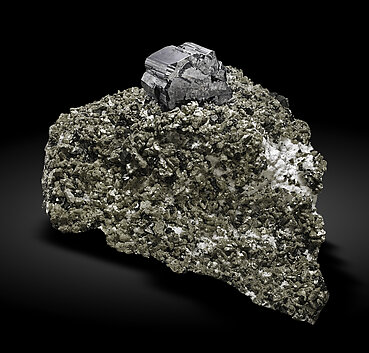
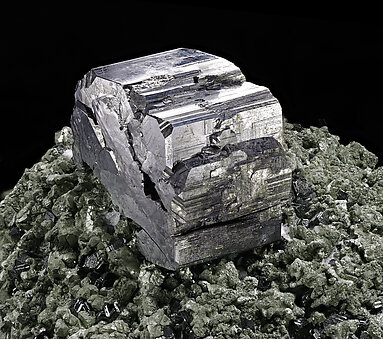
Galena with Quartz  


Galena with Quartz  
Galena with Quartz. Galena with Quartz.
Galena with Quartz.

EP40AI6
The well known aesthetics of the Kosovar samples enhance some minerals that are currently considered as “modest,” as is the case with this Galena that forms cubo-octahedral crystals that are twinned according to the spinel-law, some of them flattened, all them extraordinarily bright and on matrix with Quartz crystals.


Stan Trg (Stan Terg, Stari Trg) Mine, Trepča Complex, Trepča Valley, Kosovska Mitrovica, Kosovska Mitrovica District
Kosovo

2017


Specimen size: 17.6 × 11.3 × 6.5 cm = 6.93” × 4.45” × 2.56”

Main crystal size: 3.6 × 2.5 cm = 1.42” × 0.98”


  Silver with Calcite

Kongsberg mining district, Kongsberg, Buskerud County
Norway


Calcite fluorescent short UV

Specimen size: 6.9 × 4.8 × 3 cm = 2.72” × 1.89” × 1.18”

Silver with Calcite. Silver with Calcite.

NT67AH3
Silver from Kongsberg is obviously part of the history of mineralogy but also of European history. On this sample the Silver has grown forming delicate arborescent aggregates of small octahedral crystals included in Calcite and on a rocky matrix.

 
  Silver with Calcite

Celestine with Sulfur  


Celestine with Sulfur  
Celestine with Sulfur. Celestine with Sulfur.

CA91AI6
Relatively common in the eighties the Celestine samples from Machov had a great success in the collectible mineralogical world due both for their strict mineralogical interest and the esthetic appearance of the crystals, elongated and transparent, often with smoky shades and extraordinarily bright. They are currently considered as classics of mineralogy and there are few samples for collectors. To all this we must add that the Celestine has the unusual property of being phosphorescent (during 1-2 seconds)


Machów Mine, Tarnobrzeg Municipality, Tarnobrzeg County, Subcarpathian Voivodeship
Poland

Fluorescence short UV & minor fluorescence long UV. Phosphorescent

Specimen size: 12.2 × 9.6 × 6.8 cm = 4.80” × 3.78” × 2.68”

Main crystal size: 1.5 × 0.2 cm = 0.59” × 0.08”


  Kermesite with Calcite

Kolársky vrch, Pezinok, Pezinok District, Bratislava Region
Slovak Republic

2005


Specimen size: 6.6 × 6 × 2.9 cm = 2.60” × 2.36” × 1.14”

Main crystal size: 2 × 0.3 cm = 0.79” × 0.12”

Kermesite with Calcite. Kermesite with Calcite.
Kermesite with Calcite.

EP69AJ6
Radial and fan-like aggregates of acicular Kermesite crystals. They are extraordinarily bright and have an intense deep red color, on matrix with small white Calcite crystals.

 
  Kermesite with Calcite

Pyromorphite  


Pyromorphite  
Pyromorphite. Pyromorphite.

ET92AG6
We love the classics, and when they are good then it is the best! This classic from England easily was found 100 years ago and reflects very well a period in the history of minerals in which the United Kingdom was the reference for many mineral species, including Pyromorphite.
Roughton Gill is an old mining area that forms part of the historic mining district of Caldbeck Fells, well known since the 18th century for its exceptional mineral diversity and for producing many classic specimens highly valued by collectors.
The Moutet collection from Marseille is the origin of this piece and the label of the prestigious shop Deyrolle de Paris that accompanies it is as historic as the Pyromorphite itself.

Geologically, the mineralization there occurs in hydrothermal veins cutting Ordovician volcanic and volcanosedimentary rocks of the Borrowdale Volcanic Group. These veins mainly host lead and zinc mineralization with numerous secondary minerals developed in the oxidation zone. Among them, Pyromorphite and Mimetite are particularly notable; in Roughton Gill the Mimetite commonly occur in the form historically known as 'campylite', characterized by short, curved, barrel-shaped crystals typically showing brown to orange colors.


Roughton Gill, Caldbeck Fells, Allerdale, former Cumberland, Cumbria
England / United Kingdom


Minor fluorescence short UV

Specimen size: 5 × 4.3 × 3.1 cm = 1.97” × 1.69” × 1.22”

Main crystal size: 1.1 × 0.9 cm = 0.43” × 0.35”


  Previous Page Previous Page Next Page Next Page Arriba
Back to the Index of the Reference Specimens
 
Home page - Minerals  Comments  Minerales.info  Feedback Form  Search  
Home
page
Minerals
 Comments Minerales.info Feedback
Form
 Search