|
| |
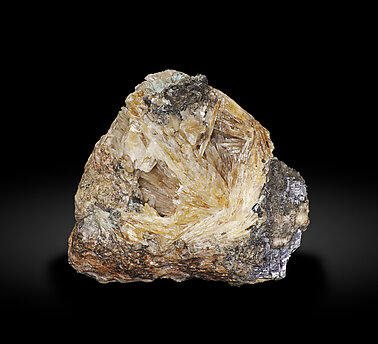
A super-classic English specimen from Leadhills, type locality for both Lanarkite and Caledonite. Lanarkite is clearly the dominant species, forming extensive orange-coloured coatings with good crystals, well developed and in good state of preservation, especially visible on the front of the specimen.
In another area of the specimen Caledonite is also present, with its characteristic sky-blue colour, adding colour to the whole. More discreetly associated are Phosphohedyphane, integrated in the matrix, and Galena.
On the back of the specimen a growth of Vanadinite is observed, forming small aggregates of orange-reddish crystals, whose identification contrasts with the ‘Leadhillite’ indication present on the original handwritten label. This detail, together with the preservation of the box and historical collection labels -including reference to Dr. L. Eger (Vienna) and a 1910 note- adds a notable historical and documentary value to the specimen.
The piece has been analytically studied by Dr. César Menor-Salván, confirming the presence of the cited species. The paragenesis is very unusual, since until now it was believed that these crystals associated with Lanarkite were Leadhillite. The Lanarkite-Vanadinite association may be representative of supergene alteration processes in lead deposits, where the circulation of solutions rich in sulphates, carbonates and phosphates may give rise to this association, but, as far as we know, this is the first well-documented reference to the Lanarkite-Vanadinite association in Leadhills.
Leadhills is a classic Scottish mining locality known since the 17th century for its lead workings. Leadhills is part of one of the most important districts in the United Kingdom for lead minerals and arsenic- and phosphate-rich secondary species, and is especially famous for rare minerals such as Lanarkite, Leadhillite, Caledonite and many others.
Geologically, it is a low-temperature hydrothermal system with veins hosted in Paleozoic sedimentary rocks (mainly greywackes and shales). Mineralization is dominated by Galena, with a wide range of secondary minerals formed in oxidation zones, explaining the great mineral diversity of the area.
Leadhills, Biggar, South Lanarkshire Scotland / United Kingdom
Specimen size: 5.6 × 5.2 × 2.7 cm = 2.20” × 2.05” × 1.06”
|
|



