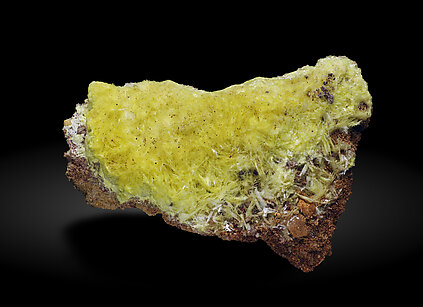
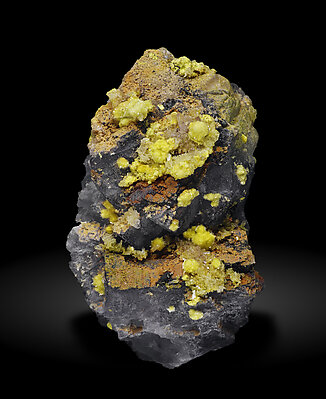
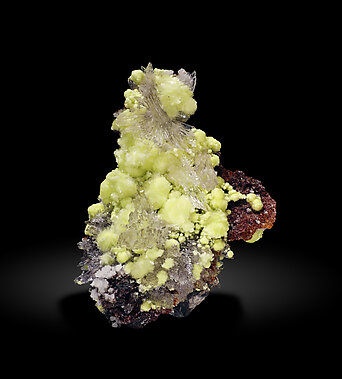
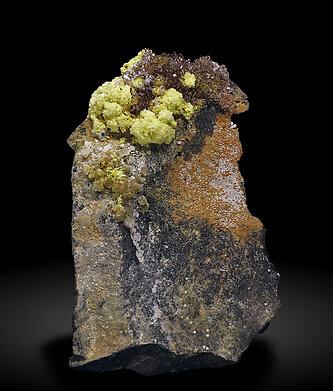
The finding of carlhintzeites in Dachang, produced at the beginning of 2025, constitutes an unexpected mineralogical event in a district traditionally known for its stibnite mineralization. Until then, Carlhintzeite had only been documented in the form of very small crystal aggregates or poorly differentiated masses, without defined macroscopic specimens. The appearance of crystals of good size therefore represents a relevant advance in the knowledge of this very rare species.
In this particularly attractive specimen, the intensely yellow Carlhintzeite forms very visible and well-individualized globular aggregates, on which acicular and fan-shaped crystals of nearly colorless Creedite are arranged, as well as very small crystals of Gearksutite. This association is consistent with the presence of late hydrothermal fluids enriched in fluorine and sulfates, typical of the post-stibnite stages of the district. The coexistence of both species suggests a final hydrothermal pulse particularly rich in volatiles, capable of generating cavities where uncommon minerals developed.
For a more detailed description of the mineralogical context and the circumstances of the find, this FMF article can be consulted: Carlhintzeite from Dachang.
The specimen has been reviewed, photographed and published as a new discovery of Munich Show 2025 in the magazine Mineralogical Record on page 299 in volume 57, number 2, March-April 2026, and it has been published in the magazine ‘Paragénesis’, number 02/2025, page 132
Dachang mining area, Qinglong, Qianxi'nan Autonomous Prefecture, Guizhou Province China (2025)
Specimen size: 3,1 × 2,3 × 1,3 cm = 1.18” × 0.79” × 0.39”
|